Features

Art World Database welcomes and promotes the sharing of editorials, essays and
papers, both scholarly and mainstream, of Southeast Asian contemporary art.

If you wish to submit a piece, please click here for submission guidelines.

Sakul Intakul

Born in Thailand
Lives and works in Bangkok, Thailand

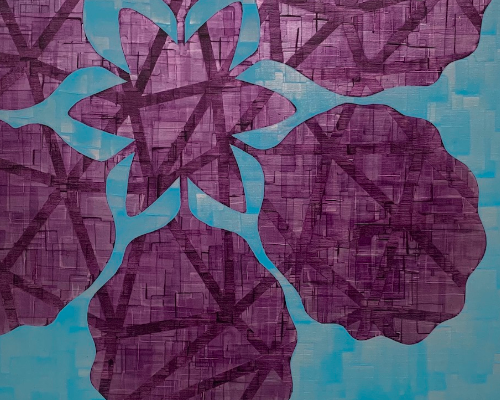
Sakul Intakul is well known for conveying spiritual ideas through plant and floral installations which possess a distinctive line, texture and sculptural quality. Sakul earned an engineering degree from King Mongkut Institute of Technology, in Thailand before pursuing his art practice.

As Sakul writes, “When a flower blooms, the Universe rejoices. From a minute scale up to the largest degree, all lives and all things in the universe are connected in many unseen dimensions. Nothing can endure all by itself. The truth and the true beauty of our universe lies in this elaborate labyrinth of connectivity from the microscopic to galactic level”.

His accolades include royal commissions from Her Majesty Queen Sirikit from 2000 to 2010 at numerous royal events, locally and abroad, as well as state banquets in the Grand Palace. He inspired the world with more than 10 books on floral art and essays on flower-inspired topics. Sakul plays an active role in being a floral culture ambassador. In 2012, he founded ‘The Museum of Floral Culture’, Thailand’s first institution of floral art. He was the museum’s executive director until its closure in 2022. Sakul Intakul’s practice is now focused on experimenting in forms of sculpture and painting, and further developing his work though NFT’s and digitally rendered artworks.

Biography information from La Lanta Fine Art, April 2023
Kong Vollak

b. 1983, Phnom Penh, Cambodia
Lives and works in Phnom Penh, Cambodia

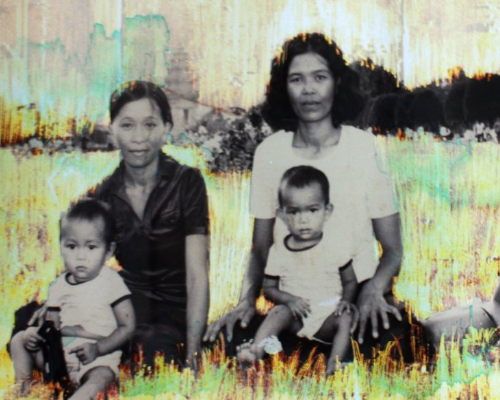
Kong Vollak graduated from the sculpture department at the Royal University of Fine Arts in Phnom Penh. Kong currently works for the Ministry of Education Youth and Sport of Cambodia as an art teacher. His artistic practice focuses on urban life and architecture; skyscrapers, wires and streets, to history and memory. Kong primarily works with charcoal, ink, photography, and multi-media sculpture. He uses techniques such as etching and lithography, and experiments with digital work.

Kong Vollak has been the curator of the ‘Mekong Art and Culture Project’ (2007). He joined Theertha International Artists workshop in Kandy, Sri Lanka (2008) and he was an artist resident at the Asian Cultural Center (ACC) in New York City, USA (2011). He also won the Bronze Medal of Sculpture from Jeux De La Francophonie, France (2013) and participated in Art Camp, UNESCO Andorra (2018).

Kong Vollak selected exhibitions include: ‘Cambodia: Looking Back on the Future’, The Flinn Gallery, New York City, USA; ‘Invisible Conversations’, Java Art Gallery, Phnom Penh, Cambodia (2017); ‘Histories of Future’, National Museum, Phnom Penh, Cambodia; ‘Silhouettes of Tomorrowland’, The Asia Foundation, Phnom Penh, Cambodia (2016); ‘Jorng Jam I’, Bophana Center, Phnom Penh, Cambodia (2014); ‘Jorng Jam II’, Logan Art Gallery, Queensland, Australia (2015); and ‘Phadeth, Bliss on Bliss Art Studio’, New York City, USA (2013).

Biography information from Aura Asia Art Project, March 2023

Sita Inyai

b. 1991, Bangkok, Thailand
Lives and works in Bangkok, Thailand

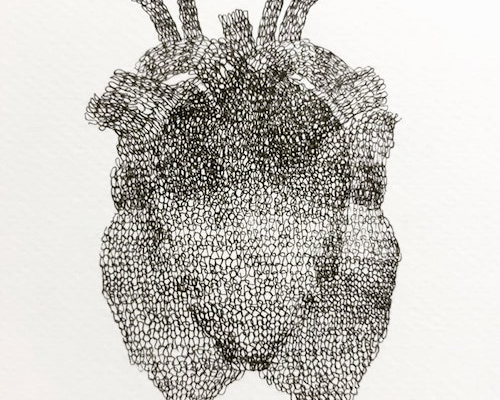
Sita Inyai graduated with a Masters in Thai Arts from Silpakorn Unitverity (Thailand). Inyai creates her work through the process of drawing, crocheting, knitting, tying, binding, and weaving metal and silk yarns. This application of mixed materials reflects the physical structure of the human body.

When asked to describe her art more broadly, she said: “It mostly revolves around the subject of the bodies and anatomies of living creatures. What distinguishes my art is the use of lines. All of it involves the creation and connection of lines — starting from one point then expanding to create the desired form. The task requires sharp focus and high levels of concentration.”

In her solo show ‘Shape Of Relationship’, Sita explored the nature of balance in its rawest forms: the relationships between humans; the relationships between humans and their surroundings; and the relationships between humans and animals. All are based on the principle of equilibrium. The exhibition offered a metaphorical picture of the omnipresent rule of balance in both explicit and ambiguous visual interpretations.

Biography information from Bangkok Post, February 2023