
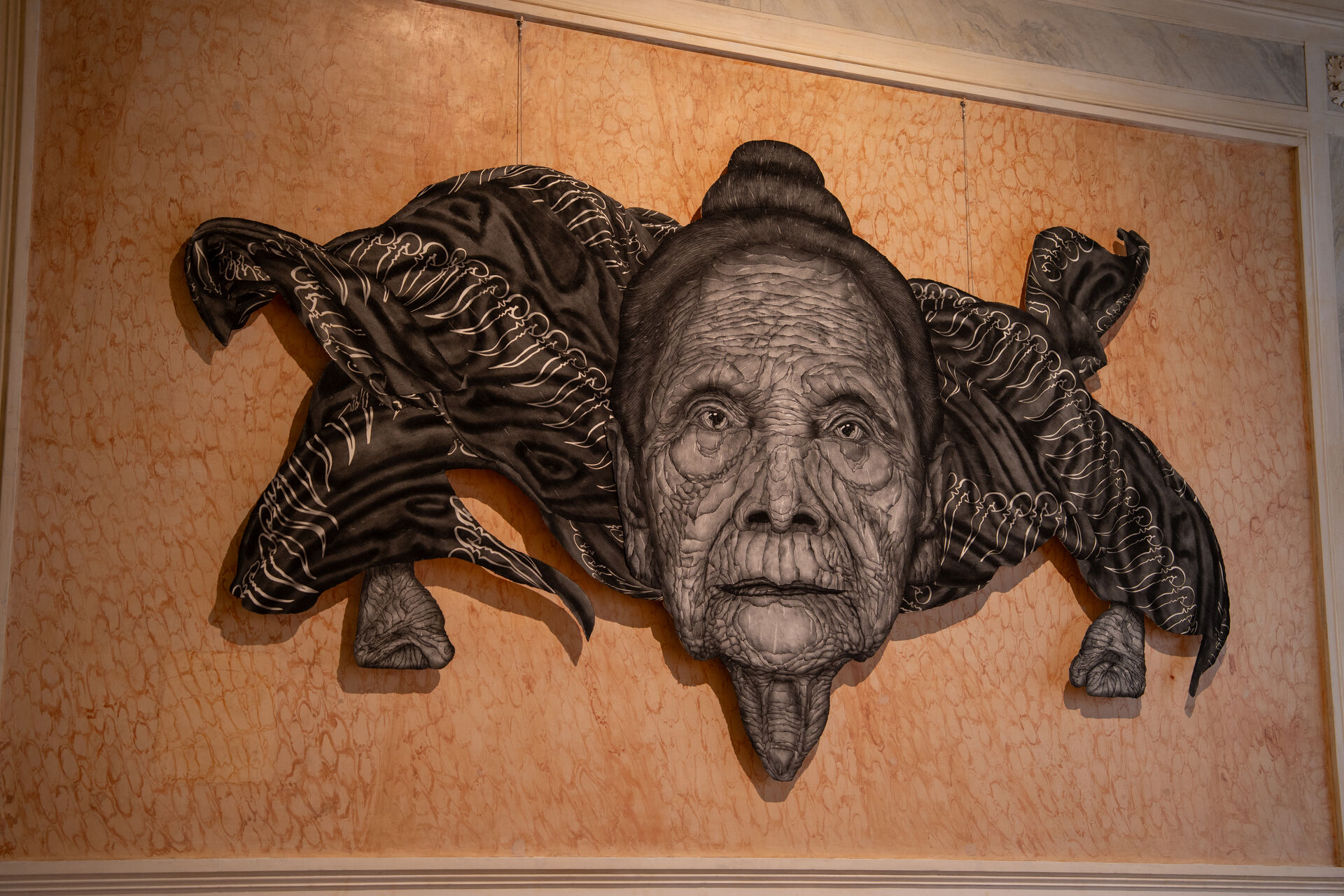
The historic Palazzo Rocca Contarini Corfù hosts the second edition of ‘The Spirits of Maritime Crossing’, a collateral event of the 61st Venice Art Biennale. Organised by the Bangkok Art Biennale Foundation and curated by Dr Apinan Poshyananda, the exhibition showcases works by 17 artists from Southeast Asia and three European artists who have previously participated in the Bangkok Art Biennale.
Across two floors of the palazzo, as well as its courtyard and gardens, the exhibition presents installations, films, sculptures, paintings and live performances. Together, these works examine cultural heritage, spiritual knowledge, and ecological vulnerability within a world shaped by historic trade routes and contemporary patterns of migration and displacement.
Bangkok and Venice – two cities defined by their intricate networks of waterways for transport and trade- provide the setting for the short film ‘The Spirits of Maritime Crossing II’ (2024). Written and directed by curator Dr Apinan Poshyananda, it reunites Serbian performance artist Marina Abramović and Thai choreographer Pichet Klunchun, who previously collaborated on the 2022 film of the same name. They are joined by Serbian artist Aleksandar Timotić, Irish artist Amanda Coogan, and Thai actress Pimdao “Mutmee” Panichsamai in a tale that follows a spirit seeking both inner peace and revenge. Water shapes both physical and spiritual journeys in many of the exhibited artworks.
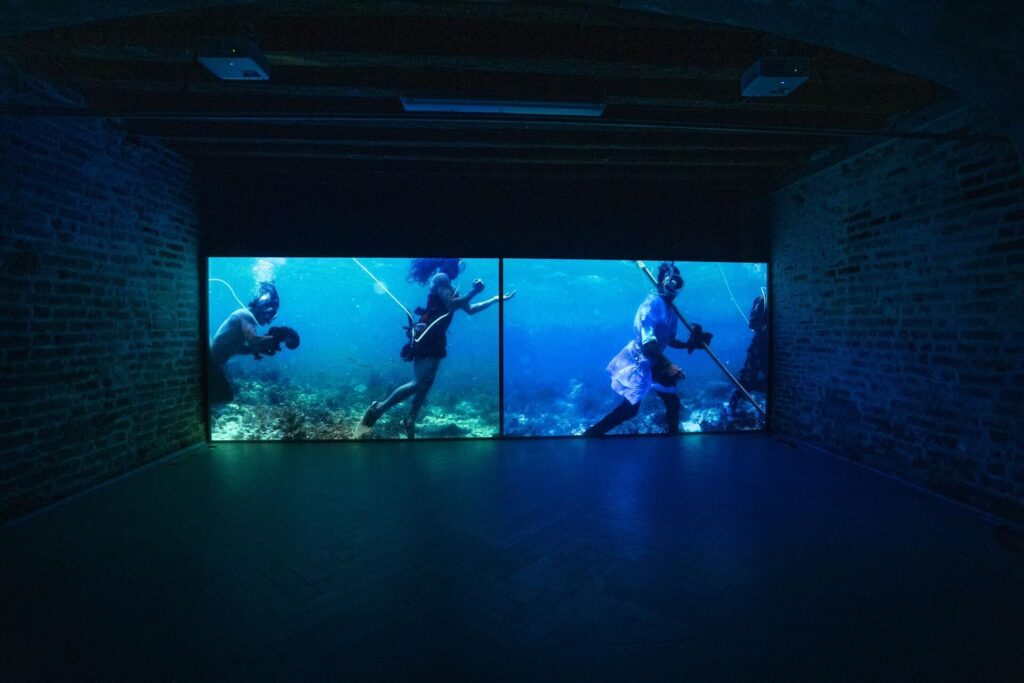
In ‘Monumentale: Ode to the Forgotten Voyage’ (2026), Thai multidisciplinary artist Wasinburee Supanichvoraparch presents large blue-and-white vessels, encrusted with sediment and coral, that appear to have just been fished out of the sea. Evoking the historic trade in chinoiserie pottery between Asia and Europe, the work also nods to his roots in a renowned family of ceramicists. Martha Atienza’s underwater processions blend Catholic faith, Indigenous traditions, and playful costumes, reimagining the Ati-Atihan Festival held each January. Her video ‘Our Islands 11°16’58.4” N 123°45’07.0” E’ (2017) draws on her family’s seafaring history. It addresses the challenges faced by fishing communities on Bantayan Island in the Philippines, where the artist grew up. Ong Kian Peng employs AI to speculate on Singapore’s future amid rising sea levels.
In the video ‘Disaster Free’ (2024), a young narrator describes how people adapt to new realities as the water rises. The film interrogates climate change and human vulnerability, while emphasising resilience and adaptability. This theme also resonates with Venice’s own precarious situation in the face of increasingly frequent high tides. Two Thai artists examine the impact of human activity on aquatic ecosystems. Parada Wiratsawee’s realist sculpture series ‘Invasive Alien Species’ (2025) depicts deformed, hybrid creatures—half human, half fish—referencing the introduction of non-indigenous species. Ruangsak Anuwatwimon’s diorama installation ‘Excavated Gods’ (2021) recreates more than 800 kilometres of the Mekong River’s banks, incorporating organic and mineral samples from six provinces in Thailand.
Just as the Mekong River flows across borders —rising on the Tibetan Plateau and in the mountains of Yunnan, then passing through Myanmar, Laos, Thailand, and Cambodia before reaching its delta in Vietnam—people have long moved within Southeast Asia, carrying collective and personal mythologies and memories with them. Sornchai Phongsa’s mixed-media works mediate between the ancestral beliefs of the Mon, a minority group in Thailand and Myanmar, and contemporary life. Raised in western Thailand, where his grandparents migrated from Myanmar, he unpacks questions of masculinity shaped by his patriarchal Indigenous origins and his LGBTQ+ identity.
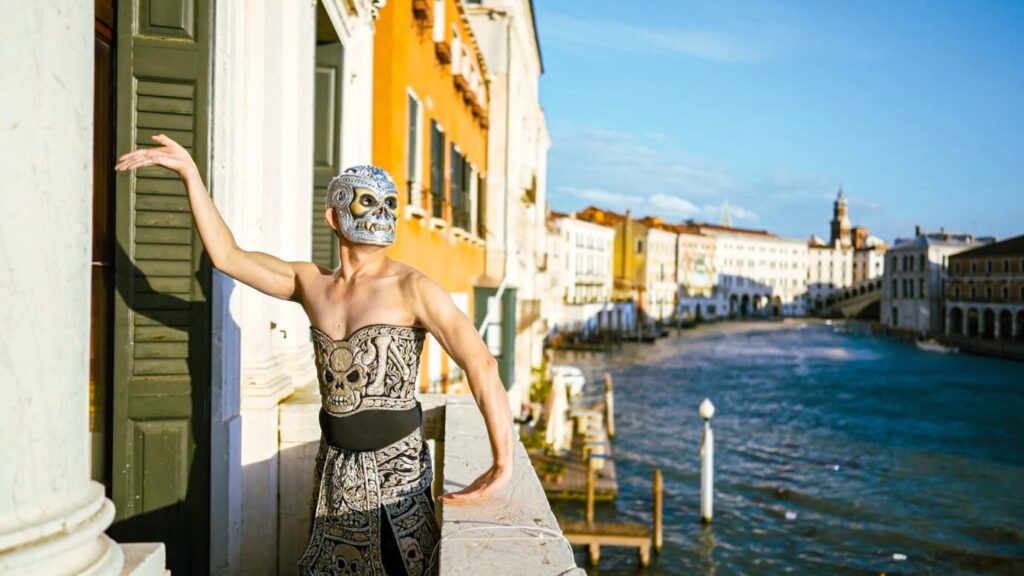
Swannie, born in Myanmar and now living in Bangkok, turns to traditional Burmese dance in the autobiographical performance ‘A Body on Repeat’ (2025). Dressed as a dying fish washed up on the shores of the Irrawaddy River—Myanmar’s main waterway—the artist explores social pressures on trans identity, as well as experiences of displacement and ancestral memory. From Laos, Tcheu Siong presents three large textile works featuring bold figurative motifs rooted in the Hmong spiritual world and culture, while departing from traditional geometric abstraction. Samboleap Tol’s interactive sound installation ‘Dharma Songs’ (2023) is inspired by her effort to trace her family’s refugee history from Cambodia to the Netherlands. Visitors dip a flower into a water-filled gong—echoing a Vesak ritual—to activate recordings of questions that the artist’s friends and family have addressed to ancestors.
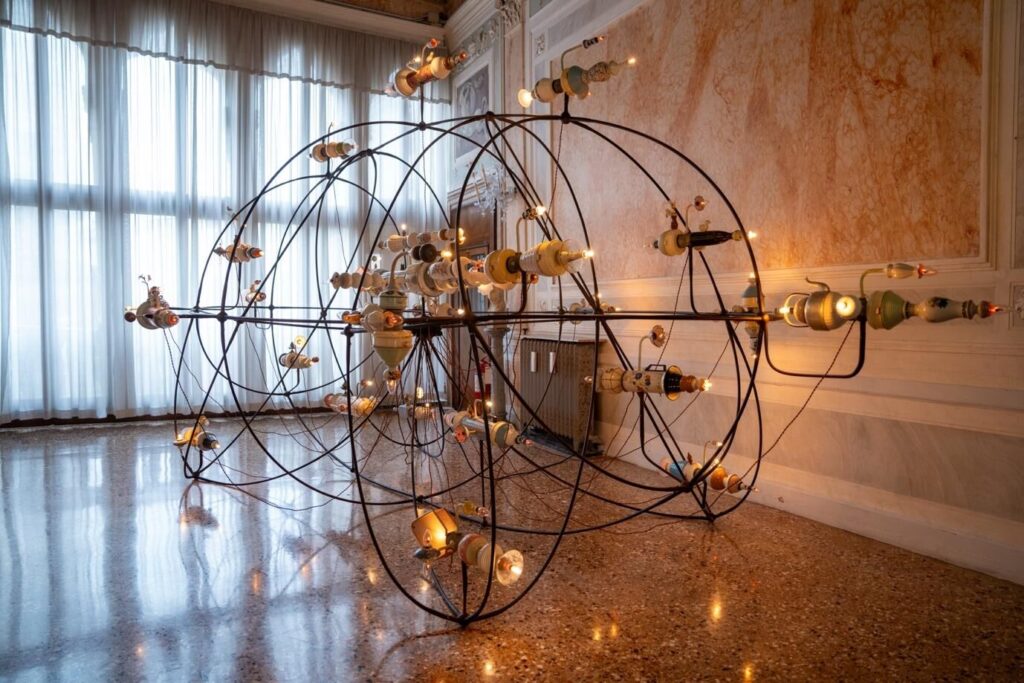
‘Spiritual Spaceship Orbit’ (2026) serves as a vessel for the personal memories of Torlarp Larpjaroensook, who recalls stories of the moon told by his grandmother, who escaped China via Malaysia before settling in Ayutthaya, Thailand’s ancient capital known as the “Venice of the East.” The retro-futuristic installation incorporates cultural and spiritual objects—traditional Thai vases, prayer lamps, and enamelled thermos flasks—referencing both the Mid-Autumn Festival in East Asia and Western space exploration.
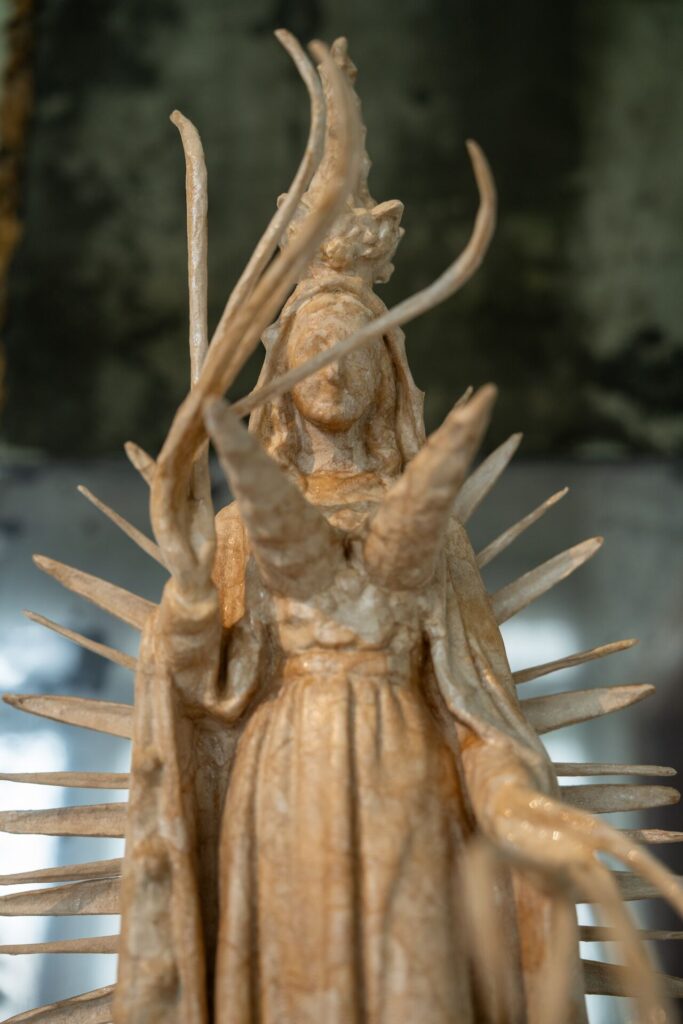
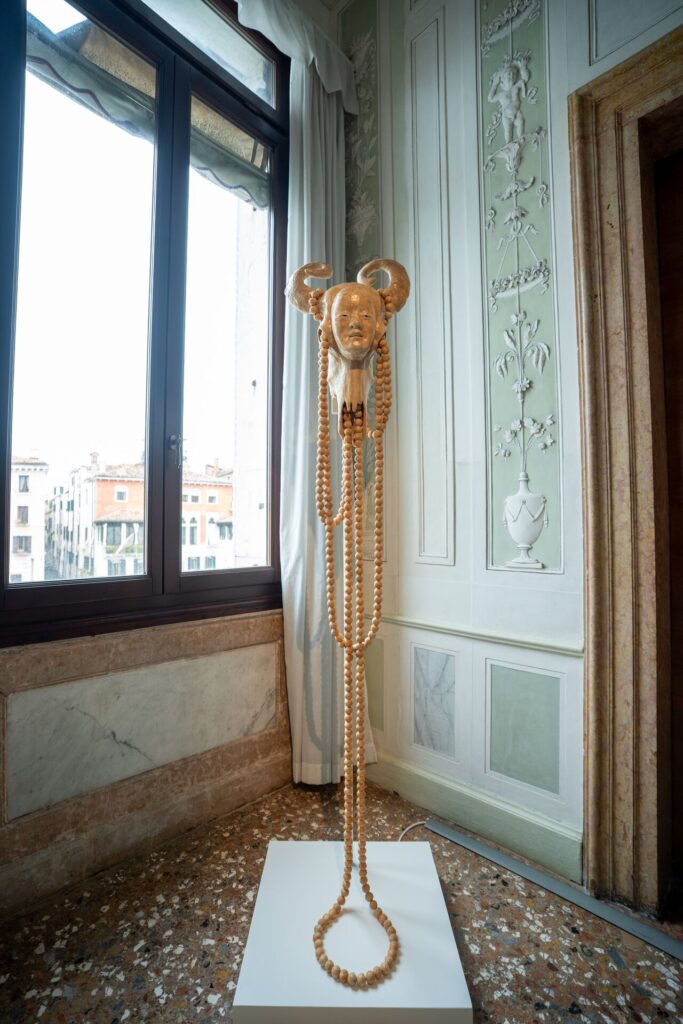
Faith and cultural hybridity are also explored in Le Hien Minh’s handmade Dó paper sculptures. With wryly humorous titles such as ‘Blessed Lady of the Nail’ (2023–2024), ‘Me So Horny’ (2025), and ‘One of These Days These Boots Are Gonna Walk Over You’ (2025), these works juxtapose sacred and profane symbols while referencing a pop culture shaped by Orientalism—one that has produced distorted images of Vietnamese women, reducing them to either sex objects or nail technicians. In dialogue with these works are the porcelain and stoneware sculptures of Soe Yu New, in which mythical hybrid creatures merge animal, plant, and human forms.
Drawing on Hindu-Buddhist beliefs, animism, and local Burmese folklore, she examines her identity as a third-generation Shan Chinese woman living in Myanmar. Although she does not describe herself as a feminist, she uses female figures—deities and historical personages—to confront gender politics and power dynamics. Indonesian artist Nadiah Bamadhaj further probes the pressures that society and tradition exert on women’s roles. In ‘The Claim’ (2026), she reimagines the past by depicting a fictional elderly female monarch who rejects the Dutch colonial patriarchal succession system and continues to rule the Javanese Islamic Mataram Kingdom well into her later years, extending the exhibition’s attention to inherited belief systems and contested power.
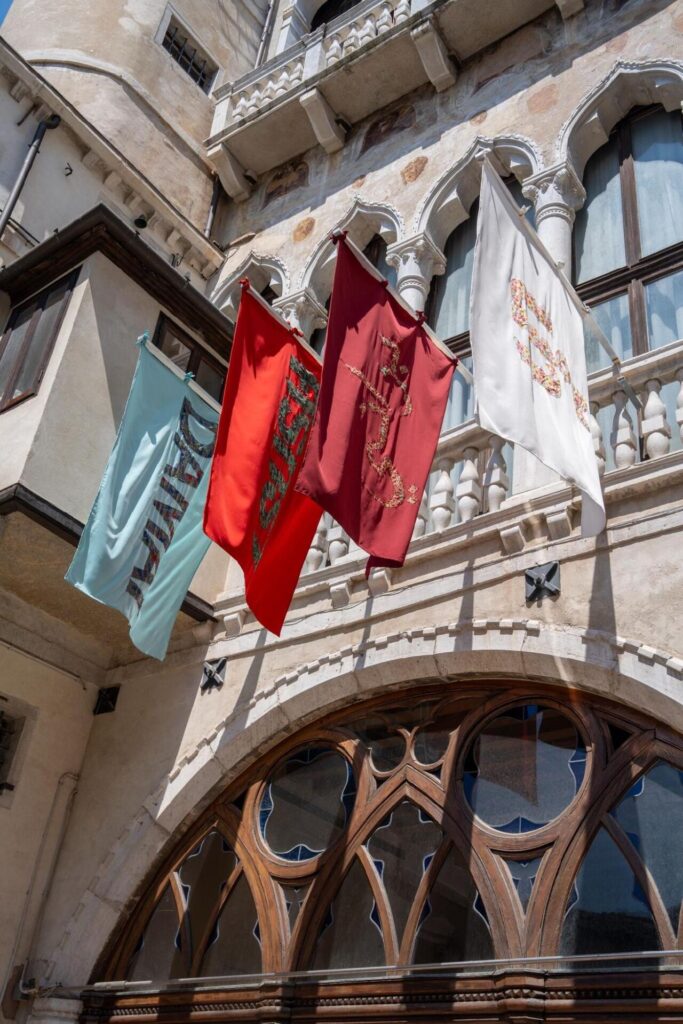
Echoing the Biennale’s main exhibition theme, ‘In Minor Key’, two artists present works that grow out of community action and quiet resistance. Arahmaiani’s ‘Flag Project’, which began as a way to confront trauma after the 2006 earthquake in Yogyakarta, in her native Indonesia, has since travelled the world, bringing communities together while reflecting on diverse socio-political and environmental issues. For the 2022 iteration, shown in ‘The Spirits of Maritime Crossing 2026’, Arahmaiani collaborated with feminist and environmental groups in the southern Thai province of Pattani to produce eleven hand-stitched flags bearing words chosen by the participants. Five of these – Brave, Faith, Nature, Peace, and Water are on view in Venice. In the single-channel video ‘Ode to Joy – Thai Sign Language’ (2024), Irish performance artist Amanda Coogan conducts a silent choir of hearing-impaired Thai youths performing Beethoven’s ‘Ode to Joy’, composed when the musician was completely deaf. Translating the symphony into movement, the performance transcends spoken language and bridges differences between Thai and Irish sign languages, reinforcing the exhibition’s emphasis on connection across differences.
‘The Spirits of Maritime Crossing 2026’ is a multifaceted exhibition that addresses regional concerns, including displacement and the fragility of the Mekong River, whose basin sustains the livelihoods of over 60 million people. The exhibition amplifies the voices of Indigenous and marginalised communities and, importantly, fills a longstanding gap by bringing Southeast Asian contemporary art to the world’s most important art event. The region has historically been underrepresented in the international art circuit, with only five Southeast Asian nations officially participating in this year’s Venice Biennale, and Thailand absent since 2019. This distinctive platform is therefore of immense importance, and it is hoped that its third edition will return to Venice in 2028, carrying the region’s dialogue forward.
‘The Spirits of Maritime Crossing 2026’ runs until 2 August 2026 at the Palazzo Rocca Contarini Corfù, Dorsoduro, Venice, Italy. For more information, please click here.
EDITORIAL BY GUEST CONTRIBUTOR ALESSANDRA DIAS, JULY 2026. FOR MORE INFORMATION, CLICK HERE.