
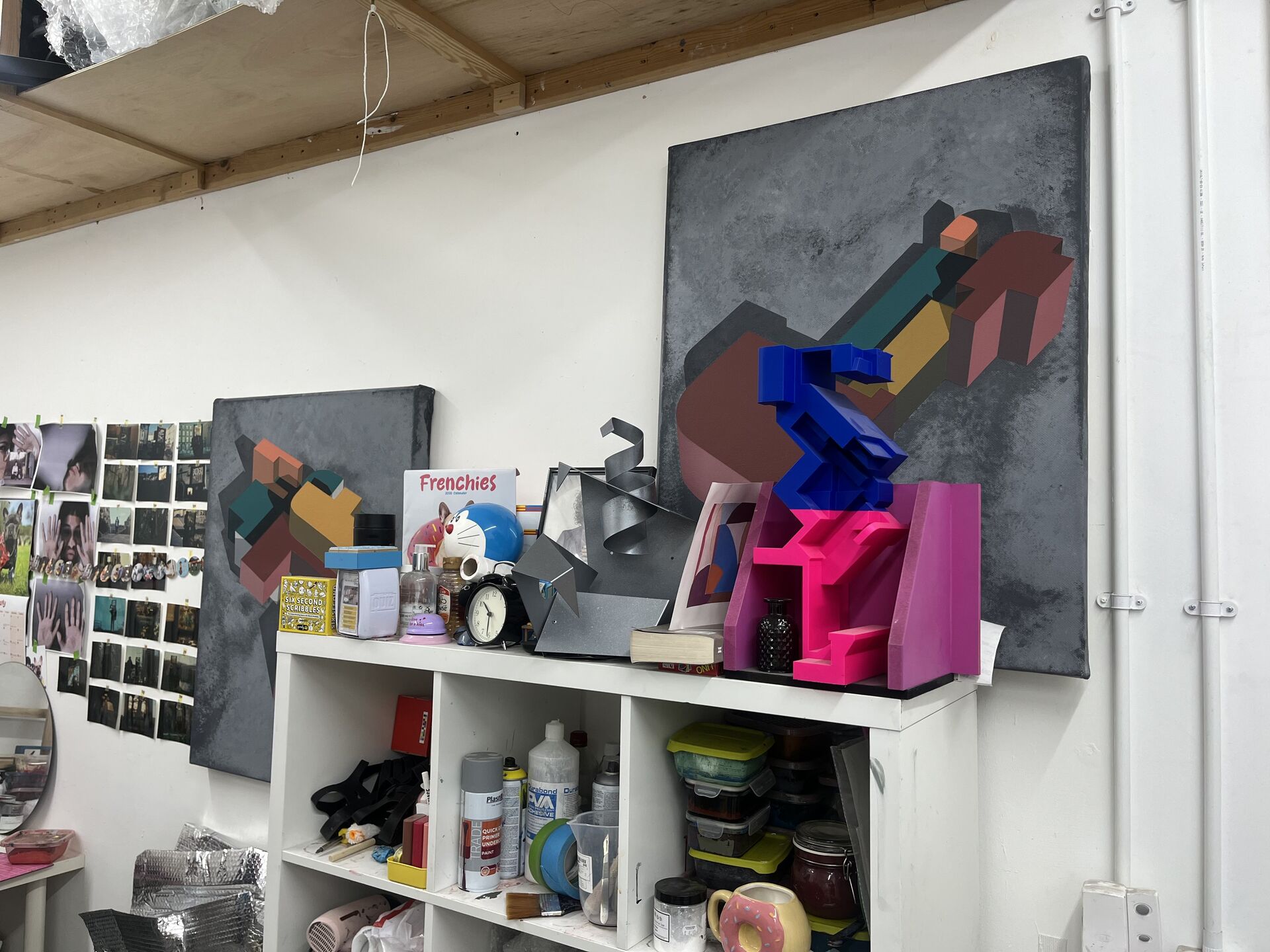
AWDB visited Indonesian artist Bunga Yuridespita at her London studio, where she spoke about her transition from architecture to art, and how memory and place inform her practice. Working across painting, sculpture, and performance, Yuridespita transforms aerial photographs of meaningful landscapes into colourful, abstract compositions.
Yuridespita, during AWDB’s visit, was developing sculptural paintings and working on her show ‘Sequestered Spaces, Fleeting Light’, a duo exhibition with Faris Nakamura at The Handbag Factory, London, which opened on 30 September. AWDB speaks with the artist about her evolving practice, the role of childhood memory, and the friendship and conversations that have shaped the collaboration.
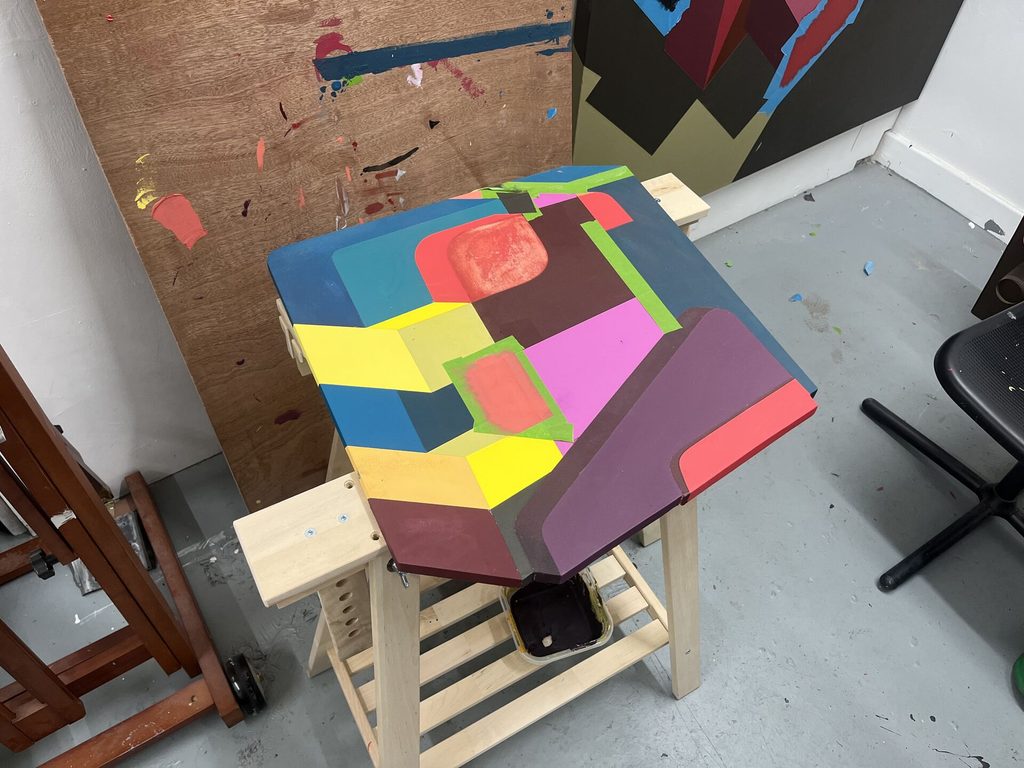
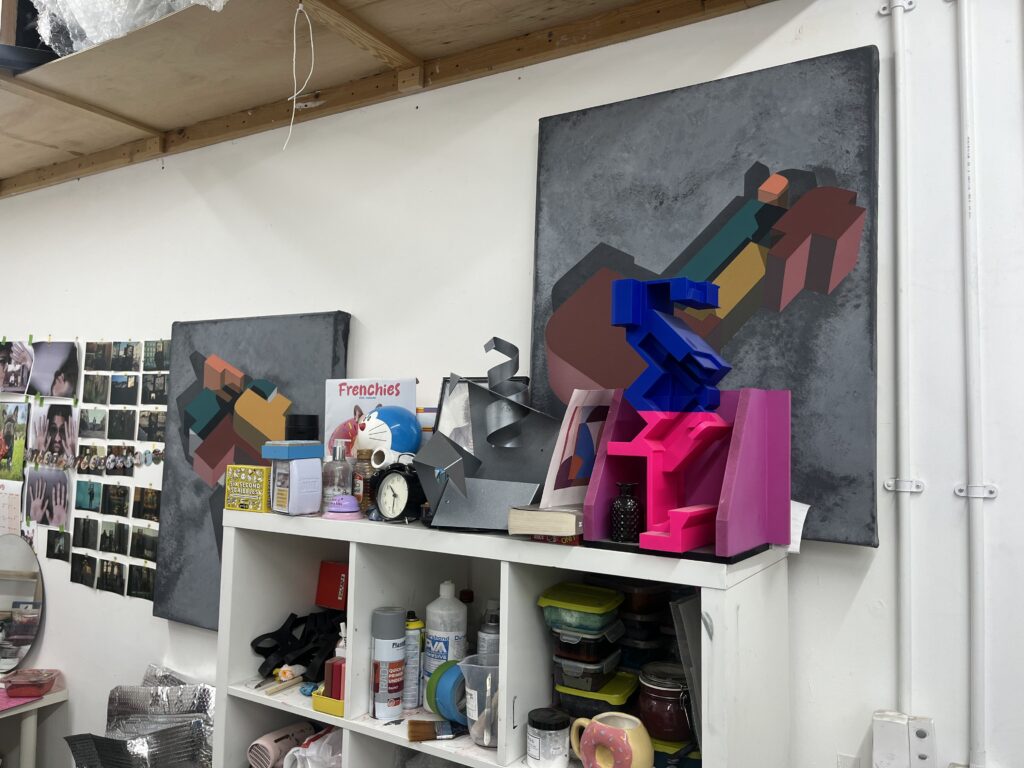
View of Bunga Yuridespita’s London studio, September 2026. Image by AWDB team
You’re currently exploring a new way of working. Could you talk about what you’re making and how this sits between your painting and sculpture?
I’m currently trying to explore a new thing. Normally I paint my works on canvas, but now I’m trying to create something a bit different, shaping the board and then painting it to make something more sculptural; they’re like sculptural paintings. These are for my next show in October with Faris Nakamura. It feels like an in-between of my sculpture and my painting.
The spaces you paint are real spaces, often seen from above and reworked from your own photographs. Could you expand on where these landscapes come from, and how your background in architecture has influenced the way you see them?
I actually started my interest in this series a very long time ago; around 2015 or 2016. I went away with my family and saw the landscape through the aeroplane window, and I found it really amazing to see that kind of landscape. I think that’s the best part of travelling somewhere by plane.
I also have a background as an architect, so I’ve seen landscape as something that you see from an aerial view, because that’s how you start designing something. You start by seeing how it looks from above, from the bird’s-eye view, and then you start zoning which area is for residential, public space, open space, or commercial space, while considering the lighting, circulation, and landscape itself.
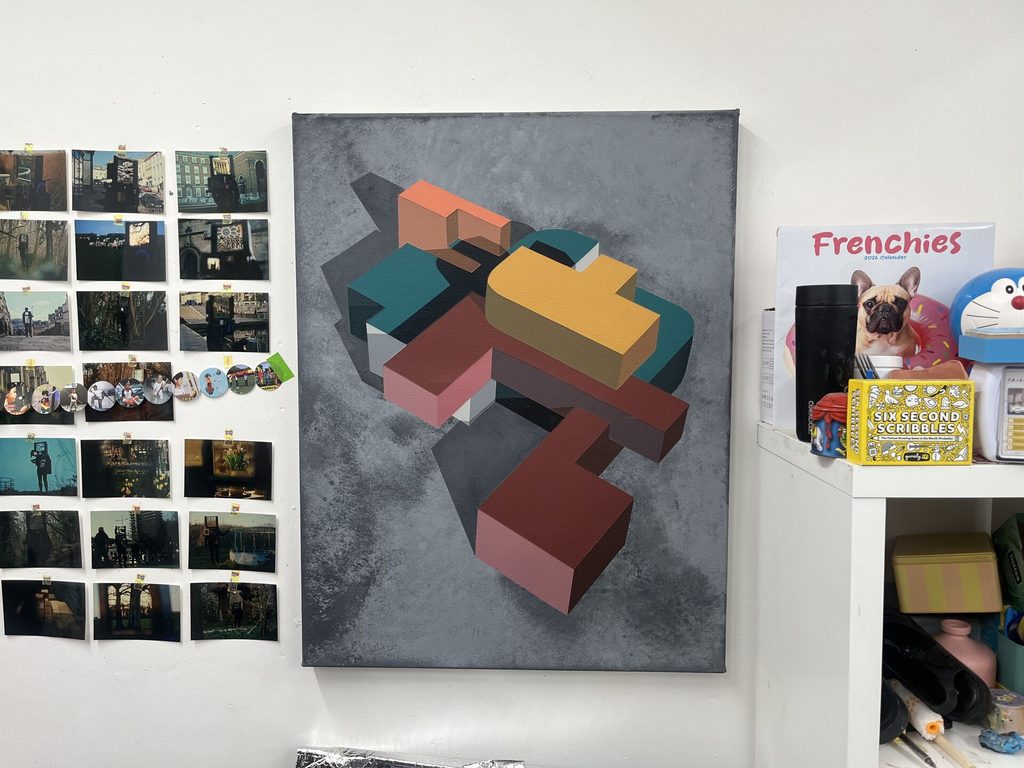
I have a drone camera, and all the shapes in my work are actually real spaces. I take pictures from above, then trace the shape of the building or the street and turn it into an abstract painting. I remove the essential architectural elements, like scale. I’m not strict about scale anymore, and I’m not strict about the function of colours either. In architecture, if you put red, it means commercial; orange means residential; green means open space. I remove those things completely.
Sometimes I use the colour palettes from my favourite cartoons when I was a kid, including ‘Doraemon’, ‘Sesame Street’, and ‘Ninja Hattori’. That’s why it’s very playful. I want to build my own wonderland by creating the space. I always choose places that are really meaningful to me. I have pictures from when I was at school and kindergarten, and I shape them into something with a Lego vibe. I always try to make it colourful and cheerful, because I’m tracking what happened in my life that shaped me into the person I am today.
How has moving from Indonesia to London, and your shift from architecture to art, changed the way you see your surroundings?
I used to work as an architect for quite a long time, probably nearly five years, but even before architecture I was really interested in film. I loved cameras and really wanted to be a film director. I think my work now is a combination of my interests in film, architecture, and abstract painting.
The way I interact with cities is very interesting. Back when I was in Indonesia, we didn’t really have things like the colourful doors you see in London. When you go to a specific area here, you can identify it. If you think about Notting Hill you probably think about that colourful area, with colourful houses everywhere. It changed how I see cities and how I interact with daily life because I notice a lot of different things every day.
The landscape and the idea of home are also very different. I used to live in a small city where you could easily go hiking and enjoy nature. Now I live in London, and I think I’m in between. Indonesia is still my home, but now I have a second home. I moved here when I was 35, when everyone at that age had probably already settled their friendships and things in their life. I was starting again from scratch, trying to create new friendships, a new family, new familiar faces.
If you ask what my influence is, I think my influence is everything around me: everything I pass through, the encounters between me and new people, and between me and new spaces.
Your wearable sculpture and your first performance at your MA degree show bring together painting, sculpture, childhood, and memory. How has performance developed within your practice since then?
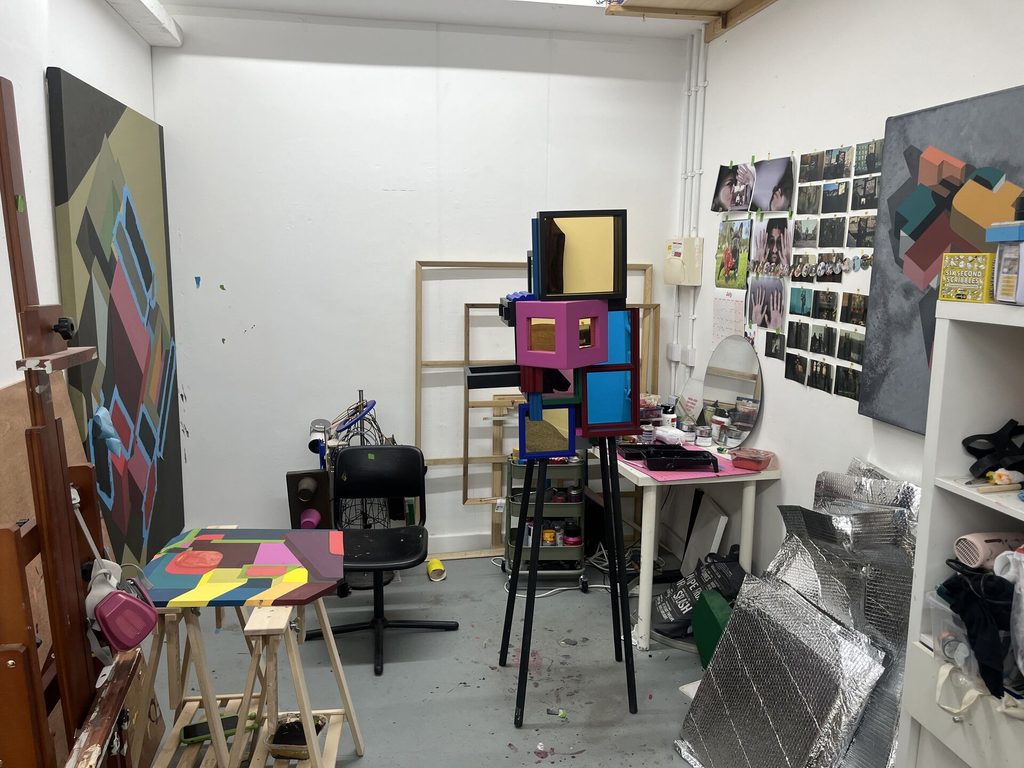
The wearable sculpture came from my previous paintings because I started to think about painting itself. These are painting stretchers*, and I combine them together and replace the canvas with mirrors. I started to define what painting actually is. Why does it need to hang on the wall? Why does it need to be two-dimensional? And why do I need to be separated from my work? There’s always a gap between artists and their work, and between artists and the audience.
*The artist was showing the interviewer stretchers in her studio
With this work, I’m blurring the gap between me and my work. When I’m wearing it, I activate the work and become part of the painting. Then people walking past become part of my work and the landscape.
My MA performance was my first performance experiment. I was wearing green and blue, and I put a picture of my childhood face on the wall and wore the same colours. It was kind of recreating my childhood and trying to make it more playful — how I wanted that kid to be raised, to be more playful and speak her mind. I was born into a religion that I never chose, and in a way society, and my parents thought certain things would be best for me. So it was about liberating myself and getting my freedom.
Performance still feels really hard for me because I see myself as the creator. I make something tangible, and performing is one way to activate this work. I’ve joined a lot of performance classes, but I still can’t see myself as a performer. When people ask what I do, I always say I’m an artist, not a performance artist.
But I’ve gained more confidence after being selected for some festivals and people started noticing my work. I always perform my works with voiceover, and I think that’s one of my strengths. I share a lot of things through my performances. I have the opportunity to speak up about humanity, and human interaction, and to build awareness. There are certain people who live like this, and they deserve to be seen, they deserve to be heard, they deserve to be their full selves, speak up, and be happy with their life.
You and Faris Nakamura share a studio and have developed a close friendship over several years. How has that relationship affected your practice, and how has it led to your upcoming duo show?
It’s really deep and powerful when I’m talking about me and Faris because it’s such a rare friendship. It’s very genuine, and we support each other. We don’t really care about each other’s work, but we do care, and don’t care at the same time. I’ve never asked about his work, and he’s never asked about my work.
But I know when he’s not in a good mood, and we know each other very well. The connection between our works is always through conversation. We sit here together, have snacks, and we don’t really talk about art. We always talk about other things, like food, and how he sees food, and for me that’s a form of art. You can’t really find anything if you’re only talking about art itself. We create things from our experience, and from our life.
Sometimes we share our thoughts about specific artworks or artists, and everything we’ve done have been like accidents. For example, I was working on a mirror installation with him, and it came about because I broke these mirrors. When I broke the mirror, I immediately collected them with my bare hands and hurt my hands. It reminded me of when I was a kid and broke a mug at home. I would collect it immediately because I was scared my mum would find it and be angry with me.
Last year, before we knew we were going to have a show together, we had a guerrilla exhibition at the Tate Modern. He made a tiny sculpture with white paper, and I responded to his work with a mirror. This was in the Quiet Room. I was carrying the mirrors in my hand and thought, the reflection they made in the room was really nice, and then we started playing with the lighting in that room.
About half a year later, a curator visited our studio. I introduced her to Faris; she liked his work, and she said, “Maybe we can make a duo show instead.” I thought, “That’s great,” because I wasn’t ready to have a solo show. It felt like a huge thing. I thought, “Oh my God, that’s perfect! That’s a dream!” A lot of people had kept saying that it would be great if we had a duo show together, so it feels really special that it’s happening.
‘Sequestered Spaces, Fleeting Light’, a duo show featuring Bunga Yuridespita and Faris Nakamura, opened at The Handbag Factory, London, UK, on 30 September and ran until 4 October 2026. For more information, please click here.
INTERVIEW COURTESY OF ART WORLD DATABASE AND BUNGA YURIDESPITA, SEPTEMBER 2026