

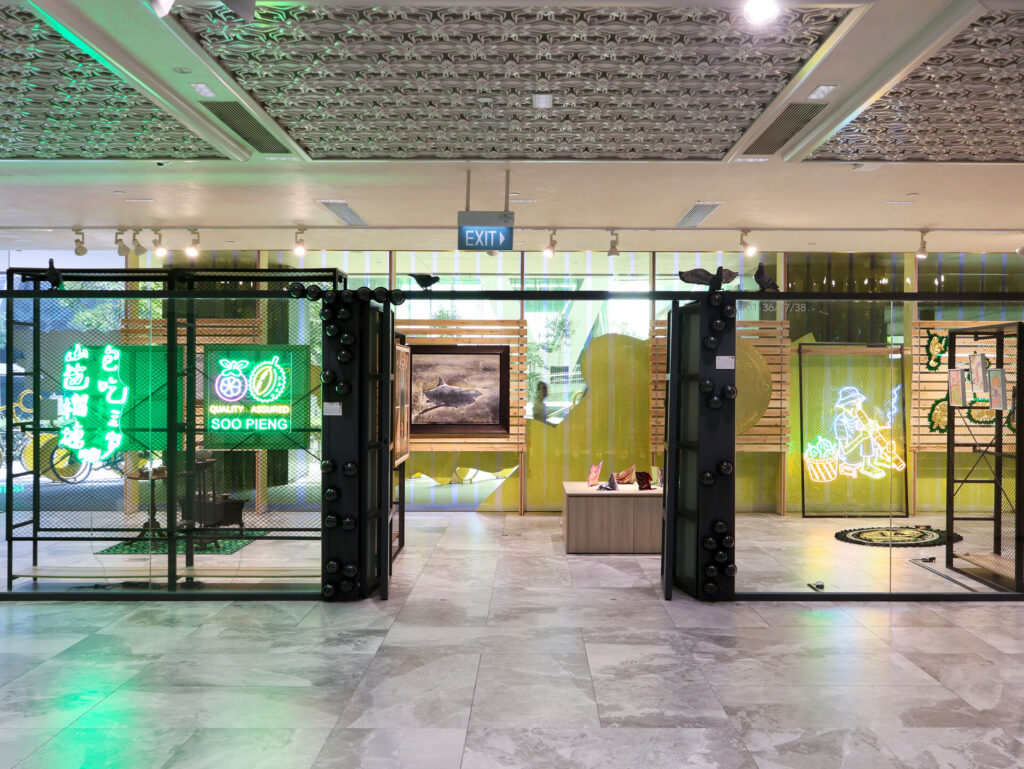
AWDB speaks to Audrey Yeo about ‘Inside the Dream of a Durian Seller’, an exhibition that uses Cheong Soo Pieng’s 1981 painting ‘Durian Seller’ as a structural prompt. The exhibition is shown in the new pop-up exhibition space Vitrine, which is located at the OUE Downtown Gallery Shopping Centre, Singapore. As the first exhibition in this space, it tests how art behaves in full public view, reaching an audience far beyond the usual gallery circuit.
Artists respond to the durian motif in many ways, from Brandon Tay’s sensory pushback to Tisya Wong’s study of measurement and perception. The result is a concise snapshot of Singaporean visual culture, examining how a familiar image can be reinterpreted when placed back into the flow of daily life.
What made Cheong Soo Pieng’s ‘Durian Seller’ the right inspiration for this exhibition, and why revisit it now?
Cheong Soo Pieng’s ‘Durian Seller’ felt like the perfect point of departure because it sits at the intersection of history, symbolism, and the everyday—exactly where contemporary Singaporean life continues to unfold. As one of our most important pioneer artists, Cheong captured scenes that were ordinary yet quietly surreal, and this 1981 painting is no exception. Its central motif—a durian seller framed by an enigmatic opium pipe, surrounded by women in batik enjoying a communal moment—offers a rich constellation of elements that speak to ritual, memory, and the rhythms of a Singapore that is rapidly fading.
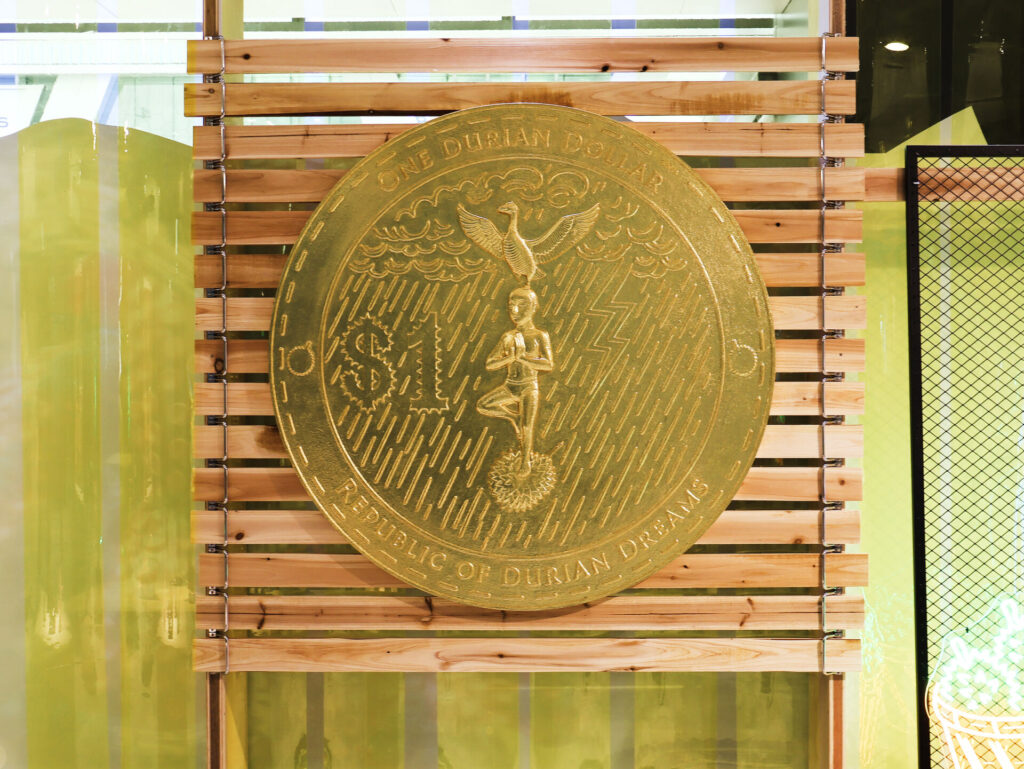
Revisiting it now allows us to reflect on how much the country has changed, and what remains emotionally resonant. The Chun U Bi brothers, who first conceived the exhibition, were drawn to this nostalgia: a longing for the Singapore they grew up with, and for the artists who shaped our cultural landscape. Their references to Lee Wen—the beloved “Yellow Man”—and to the goose emblem of The Artists Village pay homage to the pioneers who pushed boundaries long before “alternative art spaces” became part of our vocabulary.
By returning to ‘Durian Seller’, we’re not simply celebrating a national love for durians; we’re opening a conversation about community, artistic lineage, and the dreamlike quality of collective memory. It’s a way of grounding today’s new voices in the legacy of a master, while reimagining what Singaporean identity can look like in the present moment.
The Vitrine is a brand new space situated in the Downtown Gallery Shopping Centre. Does showing art in a mall allow for anything that a traditional gallery does not?
Showing art in a mall opens up different possibilities from a traditional “white cube” gallery. Downtown Gallery sees an estimated 500,000 visitors a month, compared to 500–3,000 at Gillman Barracks, depending on the cycle. Being in the CBD means we are engaging a completely different catchment — office workers, young professionals, tourists, and families who might never step into an art district. Our intention is simple: to bring art into the mainstream and integrate it into public life, rather than waiting for audiences to come to us.
We also have a vitrine-like glasshouse space where passers-by can look in and encounter the artworks on their daily commute. That level of visibility — art meeting people in the flow of everyday life — is something a conventional gallery rarely affords.
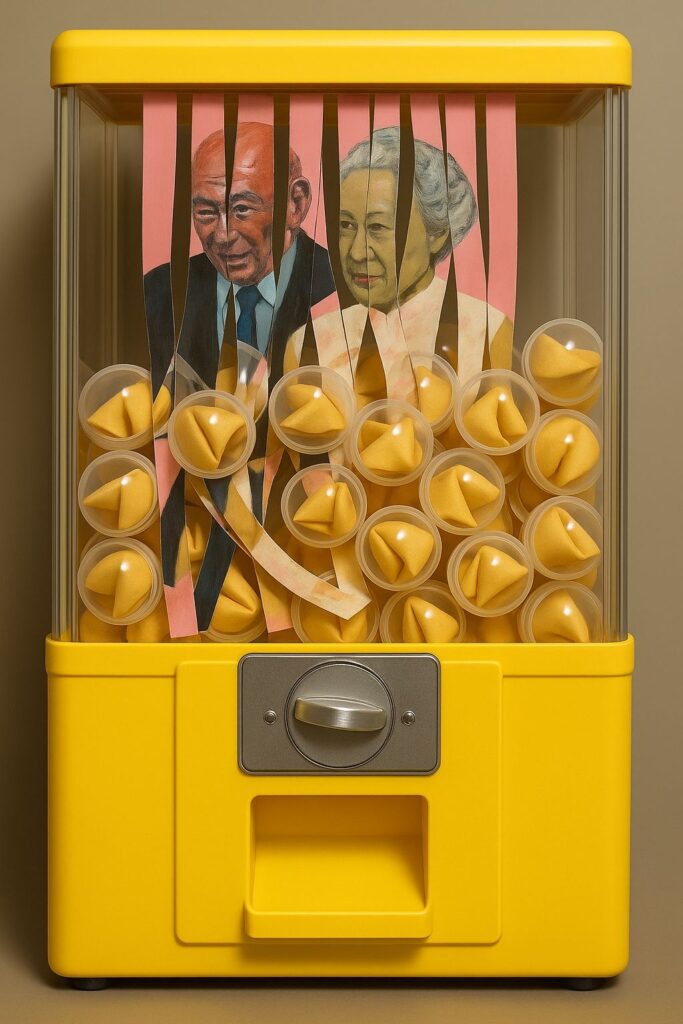
One of the artists in the exhibition, collector–artist Teng Jee Hum, contributed his own paintings as well as a collaborative work, ‘Cracking Godalisation’, 2025 — a fortune-cookie machine dispensing lines from his book (on collecting art). Teng often reflects on the idea that if art is a form of communication and the artist a communicator, then a work only fully becomes “art” when it is perceived, held, or engaged by someone other than its maker. In our context, this becomes: “Art is perceived by its audience.”
Being in a mall also allows us to activate the space differently. We’re hosting lunchtime programmes, from artist talks to intimate workshops, where participating artists share the stories behind their works — from inspiration to process, and even the playful question of why collecting art still matters today. Our hope is that the surrounding corporate community begins to see that collecting art can be both a joy and a meaningful investment in culture, creativity, and the city we live in.
What does meaningful support for emerging artists look like to you, especially in a show tied to such an iconic work?
For me, meaningful support for emerging artists is rooted in creating conditions that allow them to articulate their ideas with depth and confidence. It is not only about offering visibility, but about situating their practices within a larger artistic, historical, and social conversation. When working in proximity to an iconic painting like Cheong Soo Pieng’s ‘Durian Seller’, it becomes especially important to provide a thoughtful framework that honours the lineage while giving young artists the autonomy to expand, challenge, and reinterpret it on their own terms.
At the gallery, this translates into sustained relationship-building — with the artists, with institutional and commercial partners, and with the communities who will ultimately encounter the work. Our collaboration with Downtown Gallery is part of that commitment. By investing in the partnership with the mall and absorbing the practical demands of logistics, production, and exhibition expenses, we remove barriers that often limit what emerging artists feel they can attempt. In doing so, we open space for experimentation, scale, and site-specificity, allowing them to respond to a canonical artwork not with hesitation, but with ambition.
Ultimately, supporting emerging artists means creating a platform where their voices are not overshadowed, but illuminated — placed in dialogue with history while pointing toward the future of Singapore’s contemporary art ecosystem.
How did some of the participating artists take the durian motif in their own direction?
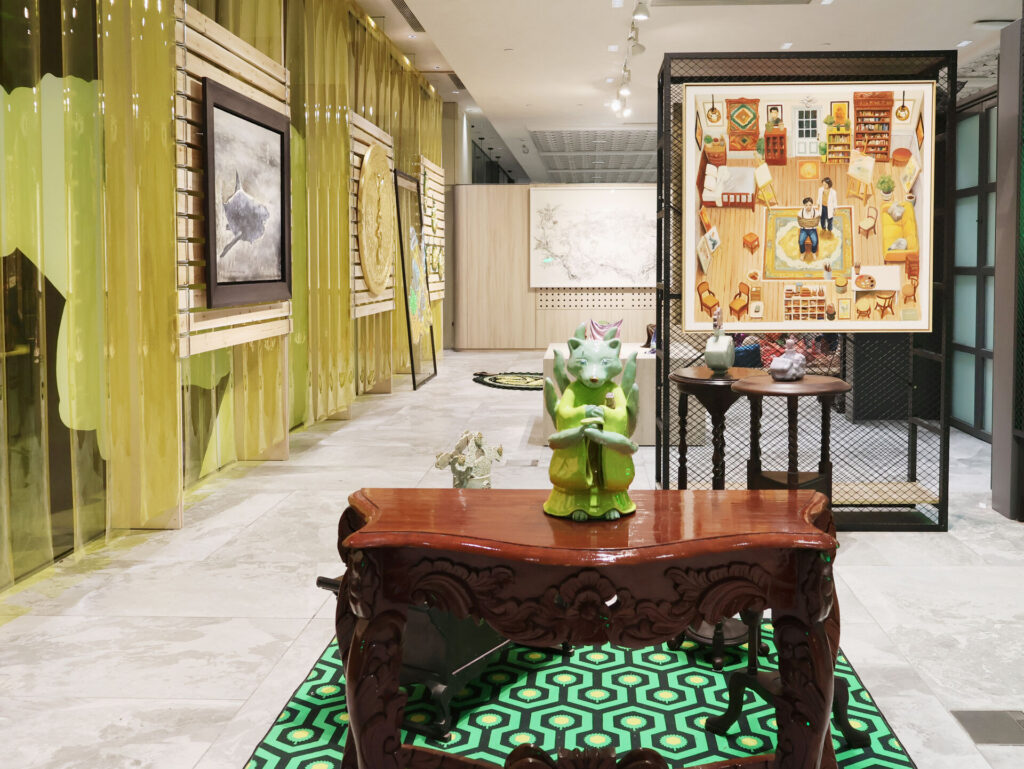
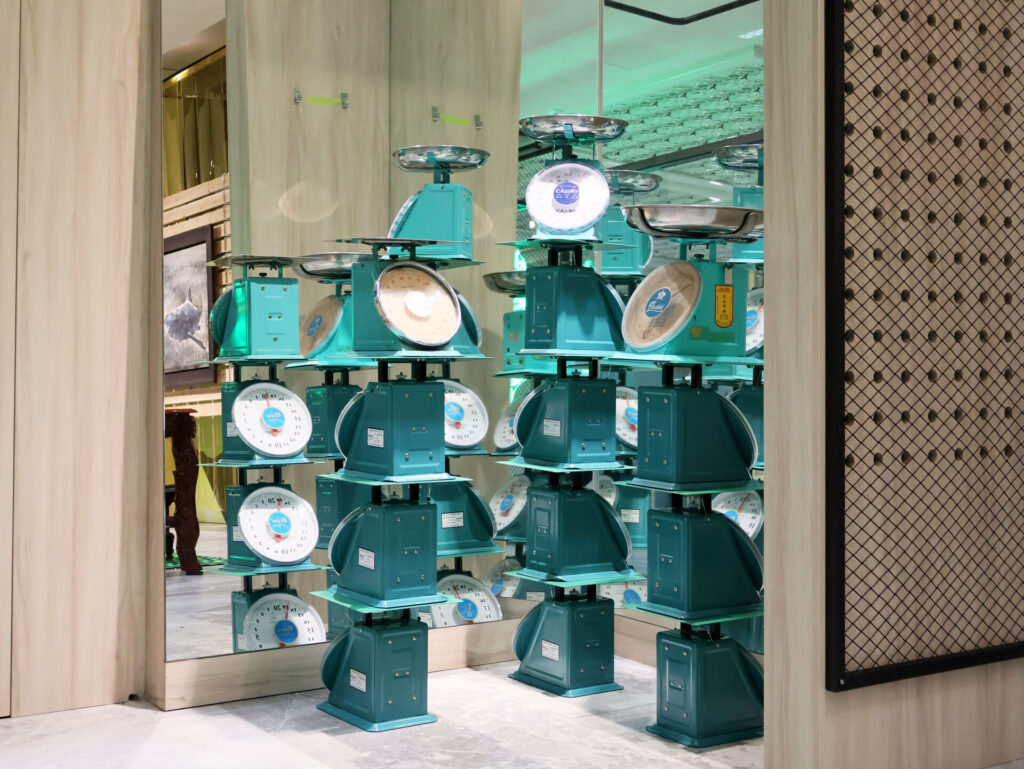
Brandon Tay, a foremost thinker of digital art and who also has a piece in the Singapore Biennale in parallel, expresses his own disgust of durians with a visceral, haptic video and sound piece. Tisya Wong, a fresh voice in local contemporary art, takes over the “dressing rooms” and will present ‘Economy of Scales’. Drawing from the practice of amplifying measurements as a sales strategy among certain durian vendors, the work reveals how perception can be shaped and leveraged, inviting viewers to reconsider the systems that define worth in everyday life.
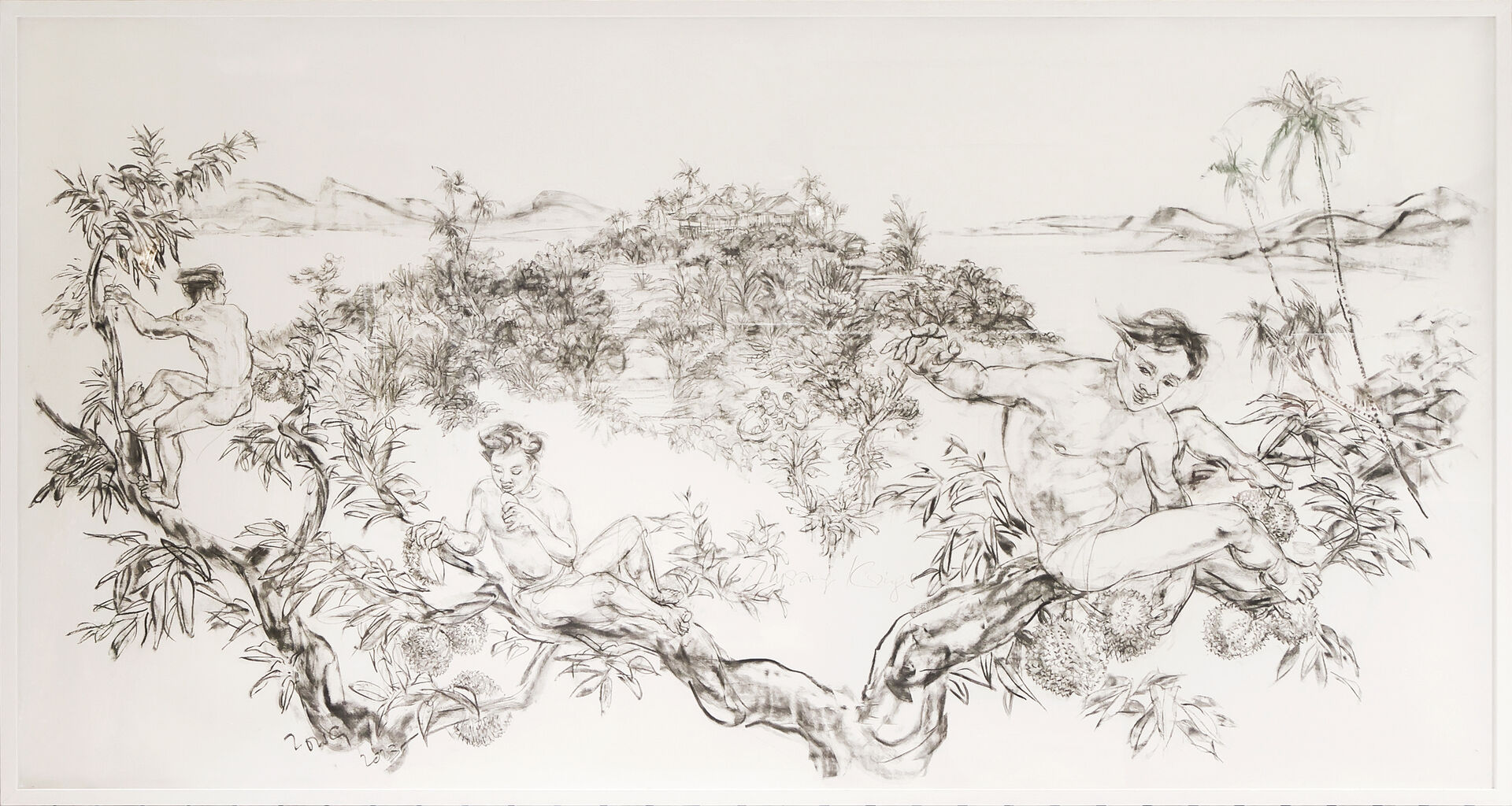
Jimmy Ong, the most senior artist in the exhibition, brings a distinctly intergenerational perspective to the durian motif. His iconic charcoal drawings — rendered in sweeping, muscular gestures — revisit one of Singapore’s most recognisable social rituals: gathering over durian. In his hands, this familiar pastime becomes a study of public assembly, masculinity, and the quiet dynamics that unfold in communal spaces. By focusing on groups of men in shared moments, Ong reframes the durian not just as food or symbol, but as a lens through which to observe intimacy, kinship, and the unspoken codes of social belonging.
For our international audience, can you narrate how the exhibition engages with Singaporean identity and nostalgia?
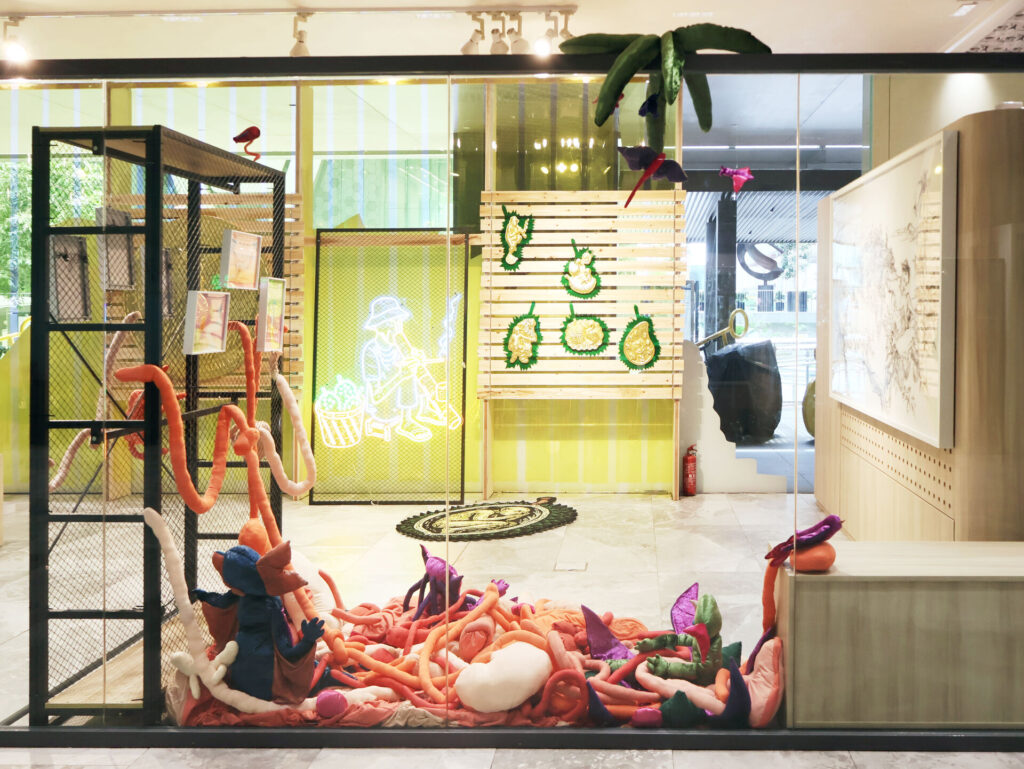
Singaporean identity is difficult to pin down in a single aesthetic or narrative, precisely because it is built from layers of cultures, rituals, and shared habits. This exhibition leans into that complexity. We’ve intentionally evoked the visual language of a neighbourhood durian stall — from the neon signage that appears across local hawker centres and fruit stands, to the informal, communal atmosphere that surrounds the act of eating durian itself. It’s a setting that many Singaporeans instinctively recognise, but it also offers international visitors an immediate sense of place.
Several artists draw directly from cultural objects and materials embedded in everyday life. Shayne Phua, for instance, incorporates traditional kueh moulds — familiar during festivals like the Mid-Autumn Festival and Chinese New Year — weaving them into a contemporary installation that speaks to heritage and reinvention. Geraldine Lim responds to local flora and fauna with subtly subversive drawings that echo the history of botanical illustration while questioning what is considered “native,” “natural,” or “ideal” in a rapidly urbanised environment.
Together, these gestures create a tapestry of nostalgia and lived experience. The exhibition doesn’t present Singaporean identity as fixed; instead, it invites audiences to feel it — through textures, symbols, and atmospheres that resonate deeply with those who grew up here, while opening doors for those encountering it for the first time.
What other themes would you like to explore at Vitrine in the future?
The Vitrine is a pop-up space, so our ability to plan far ahead depends very much on landlords. That said, the concept behind The Vitrine is driven by a desire to explore themes that can meaningfully activate the site and deepen our shared cultural understanding. Throughout this exhibition, we’ve met many new residents and expatriates who are still discovering the histories, rituals, and symbols that shape everyday life in Singapore — and it has been a genuine pleasure to share those layers with them.
One recent passer-by, who paused to look into the glasshouse space and joined a conversation about “value” in relation to Tisya’s durian-weighing work, simply said: “Art is priceless.” Moments like that capture what The Vitrine can be — a porous, accessible site where people encounter art unexpectedly and leave with a richer sense of the place they now call home.
Moving forward, we hope to continue nurturing that curiosity by creating exhibitions that open windows into the textures, humour, and complexities of Singaporean culture, always grounded in site-specificity and cultural knowledge.
‘Inside the Dream of a Durian Seller’ is on view at Vitrine, OUE Downtown Gallery, Singapore until 31 January 2026. For more information, please click here.
INTERVIEW COURTESY OF ART WORLD DATABASE AND AUDREY YEO, DECEMBER 2025