
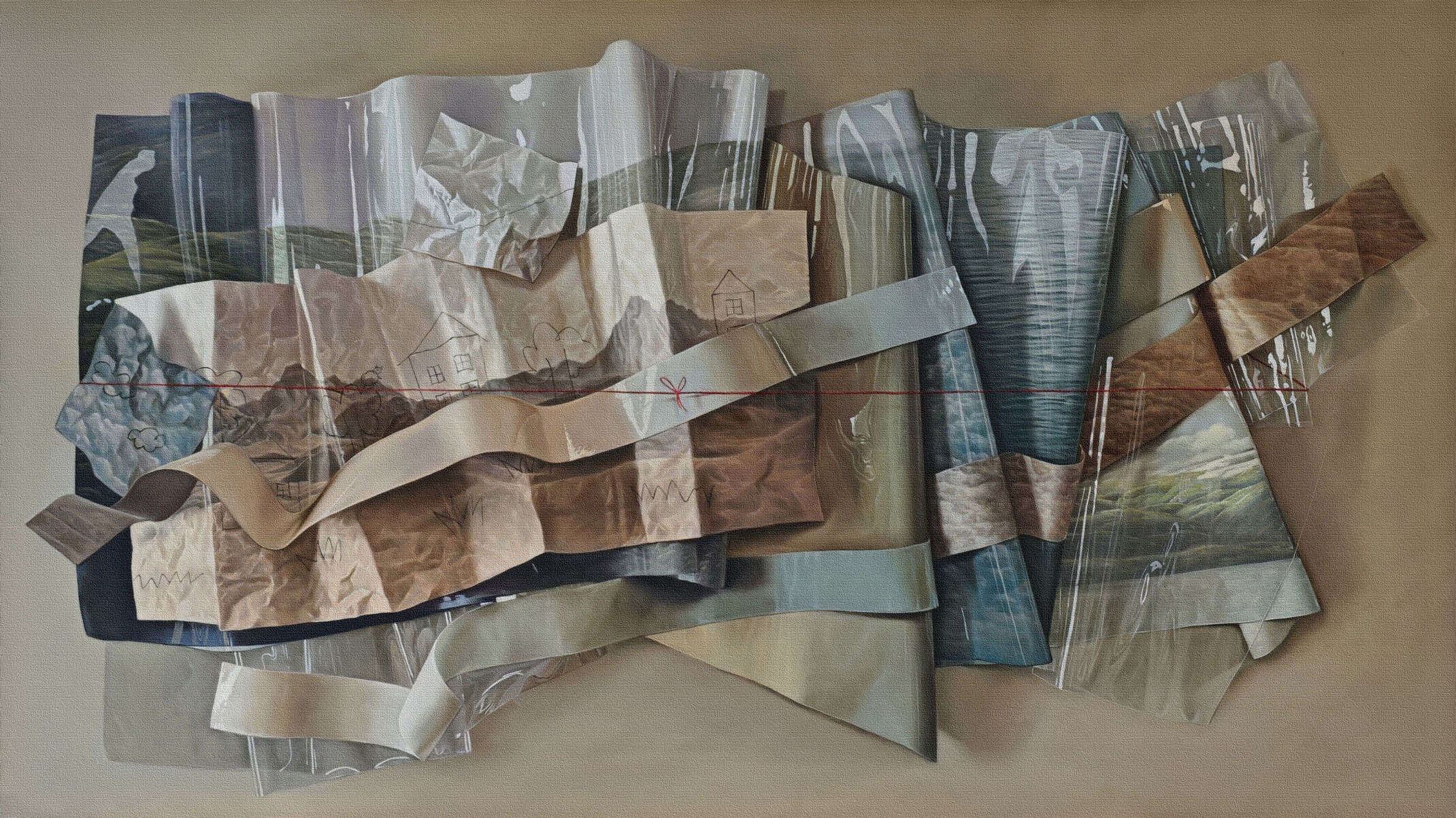
AWDB is delighted to share an interview by Euginia Tan, Exhibition Writer for Haridas Contemporary, with Singaporean artist Aiman. Working through layered oil paintings, Aiman explores how we shape our understanding of identity. His latest series, ‘Of Particles & Particularities’, reflects on the relationship between individual experience and the wider world, informed by his journey into fatherhood. The works will be presented in his solo exhibition at Haridas Contemporary, Singapore, from 7 November to 6 December 2026.
Every artist’s solo title holds a certain weight to them, especially when it encompasses a new series. Walk us through what ‘Particles & Particularities’ mean to you and how/why it reflects these new works.
I think I was drawn to ‘Of Particles and Particularities’ because there is a tension between those two words. “Particles”, for me, place us within a much larger scheme of things. At the most basic level, we are all made up of particles—the same material world that exists around us. There is something quite humbling about that. You think of yourself as this very distinct person with a distinct life, and yet materially the boundaries are perhaps not as absolute as we imagine them to be.
“Particularities” seem to move in the opposite direction. They are all the things through which we understand ourselves as specific: our memories, histories, relationships, beliefs, desires, the places we come from. Some are given to us and some, perhaps, are things we construct in order to distinguish ourselves from everyone else. They allow me to say, this is me, this happened to me, this is where I belong.
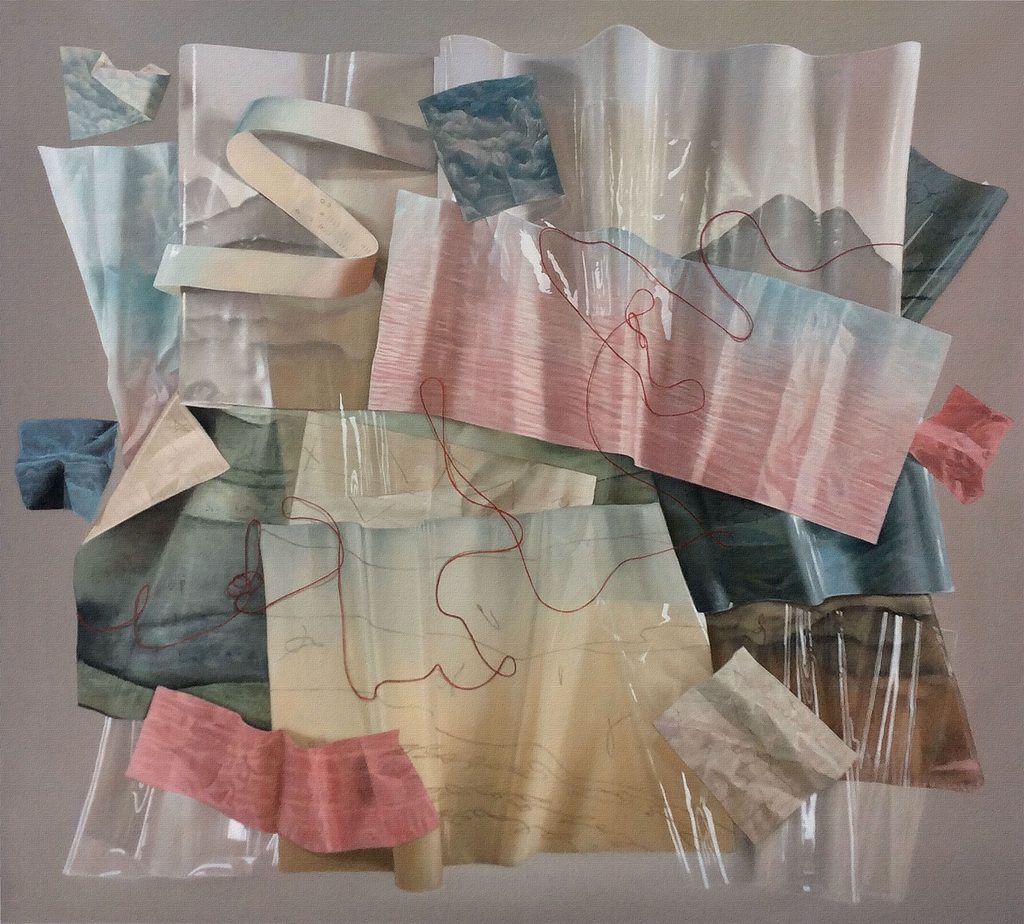
I suppose the paintings sit somewhere within that tension. I’ve described them before as “self-portraits without figures”. There are seas, deserts, mountains, skies, fragments of places I have encountered or imagined, but I’m interested in the strange way we come to understand these external things as somehow belonging to us. A landscape is completely separate from me, and yet through memory or experience it can become part of how I understand myself. I’m still trying to work out where that boundary lies.
Becoming a father has made that question feel much less abstract. For most of my life, I think I understood myself as an individual whose life was, fundamentally, my own. I’m beginning to realise that it isn’t quite that simple anymore. There is now someone who is in some sense an extension of me, and yet is completely outside of me. He will have his own life, his own particularities, many of which I will have no control over.
There is something quite strange and beautiful about that. The boundary of where I end feels slightly less certain.
I was also reading Paul Ricoeur around the time these works were developing, particularly his thinking around narrative identity. Ricoeur made me think about another side of particularity: how we make sense of ourselves through the stories we construct and reconstruct about our lives. Meaning isn’t always available to us while something is happening. Sometimes another event occurs years later and suddenly something from the past occupies a different place in the story.
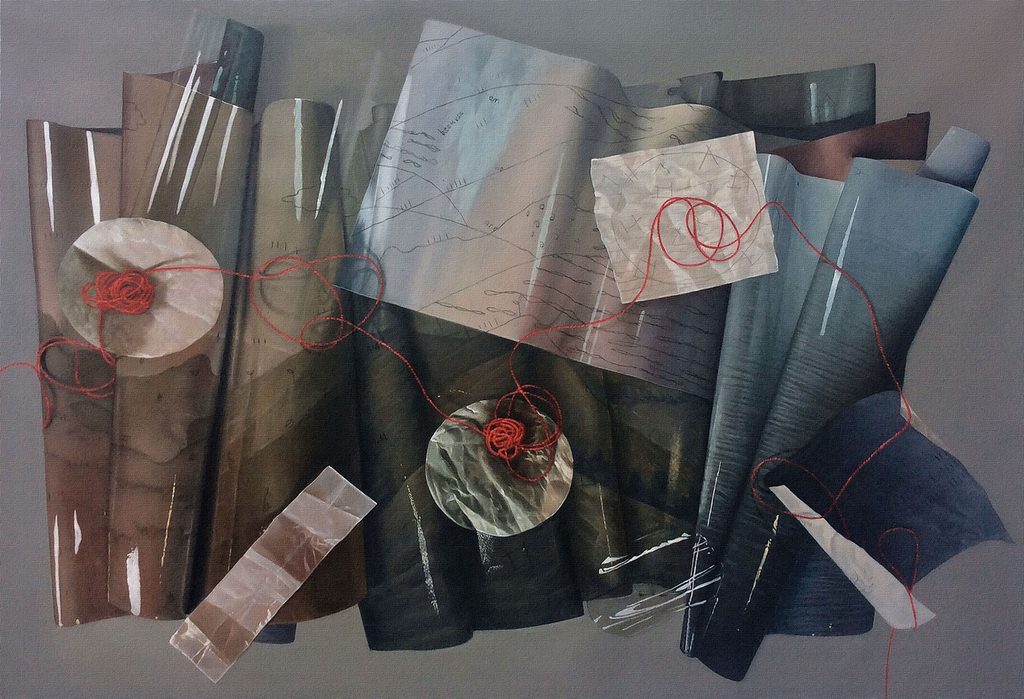
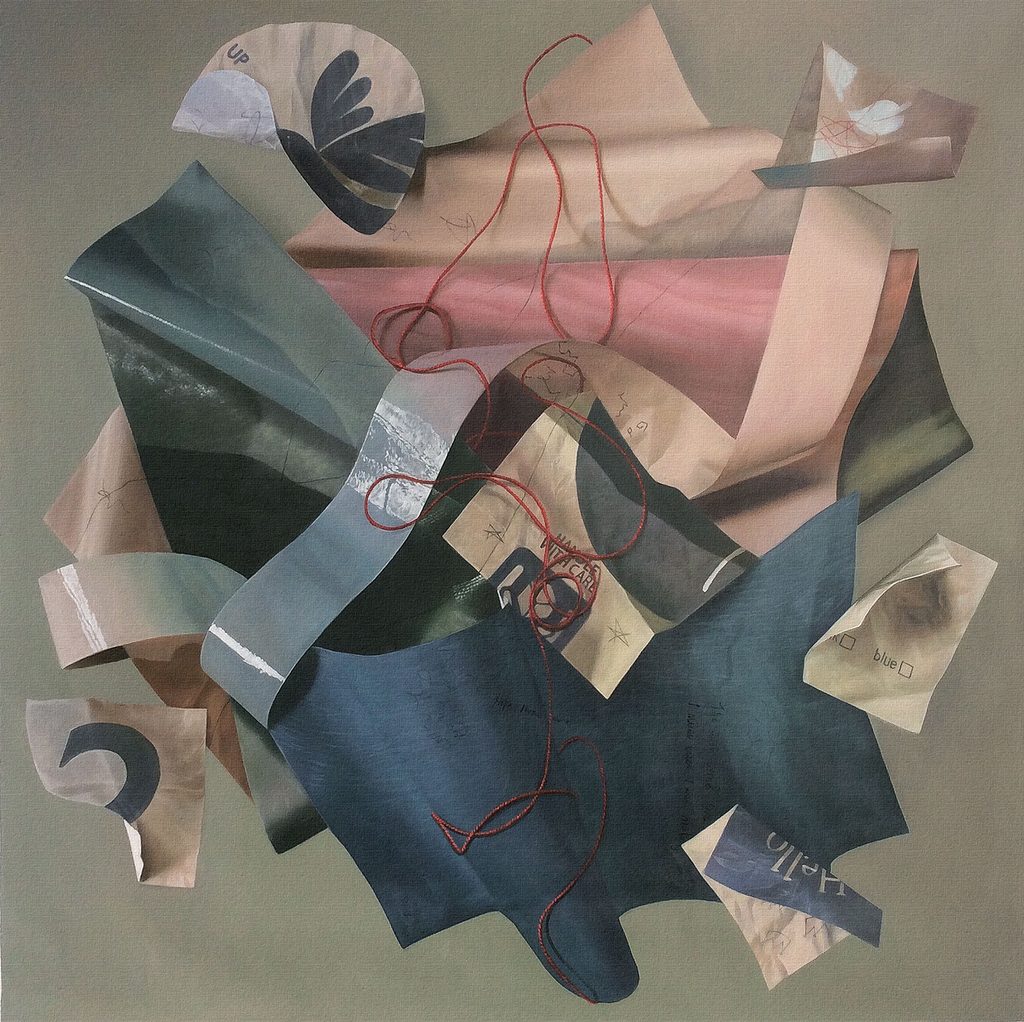
The paintings developed similarly. They accumulate layers, fragments, marks, landscapes, sometimes these red threads gathering things together. But I don’t think the aim is to finally resolve all those parts into a complete picture of a self.
Maybe that is what the title keeps returning me to. We are particular—we have these extraordinarily specific lives that matter deeply to us—and at the same time we are particles, part of something unimaginably larger than ourselves. I don’t think one cancels the other. I’m interested in what happens when you hold both thoughts at once.
As we’ve previously discussed, there is a constant voyage around notions of faith (and perhaps faithfulness) in your paintings. Where are you on this journey at present? How has it shaped your practice thus far?
I think my relationship with faith at the moment has a lot to do with unknowing. Perhaps more than certainty, actually.
There was probably a time when I thought faith was supposed to provide answers, or at least make certain things clearer. I’m less convinced of that now. Starting a family has involved so much waiting, hoping, disappointment, and beginning again, that I became very aware of how little control I actually had over the outcome. And yet you continue. You hope again. You remain with something even when you cannot quite see where it is going.
Maybe that is where faithfulness has become interesting to me. Faith asks what I believe, but faithfulness also asks what I remain with.
I’ve also been reading quite a lot from the history of Christian spirituality—Julian of Norwich, Teresa of Ávila, Nicholas of Cusa—and I think that has changed how I understand my own wrestling with faith. You realise that people have been sitting with questions of God’s presence and absence, suffering, desire, uncertainty, even the limits of what we can know about God, for centuries. We are still asking these questions now.
There is something strangely comforting about that, but also humbling. I suppose you realise that you haven’t invented your questions. You enter into a conversation that was already happening long before you arrived, and will probably continue long after you are gone.
I’ve been thinking about Hannah Arendt’s idea of natality in relation to this as well—not as a theological idea necessarily, but her understanding that every person is born into a world that is already here. We arrive in the midst of histories, relationships, tragedies, beliefs, questions. We inherit things we didn’t begin. And yet each arrival is also the possibility of beginning something new.
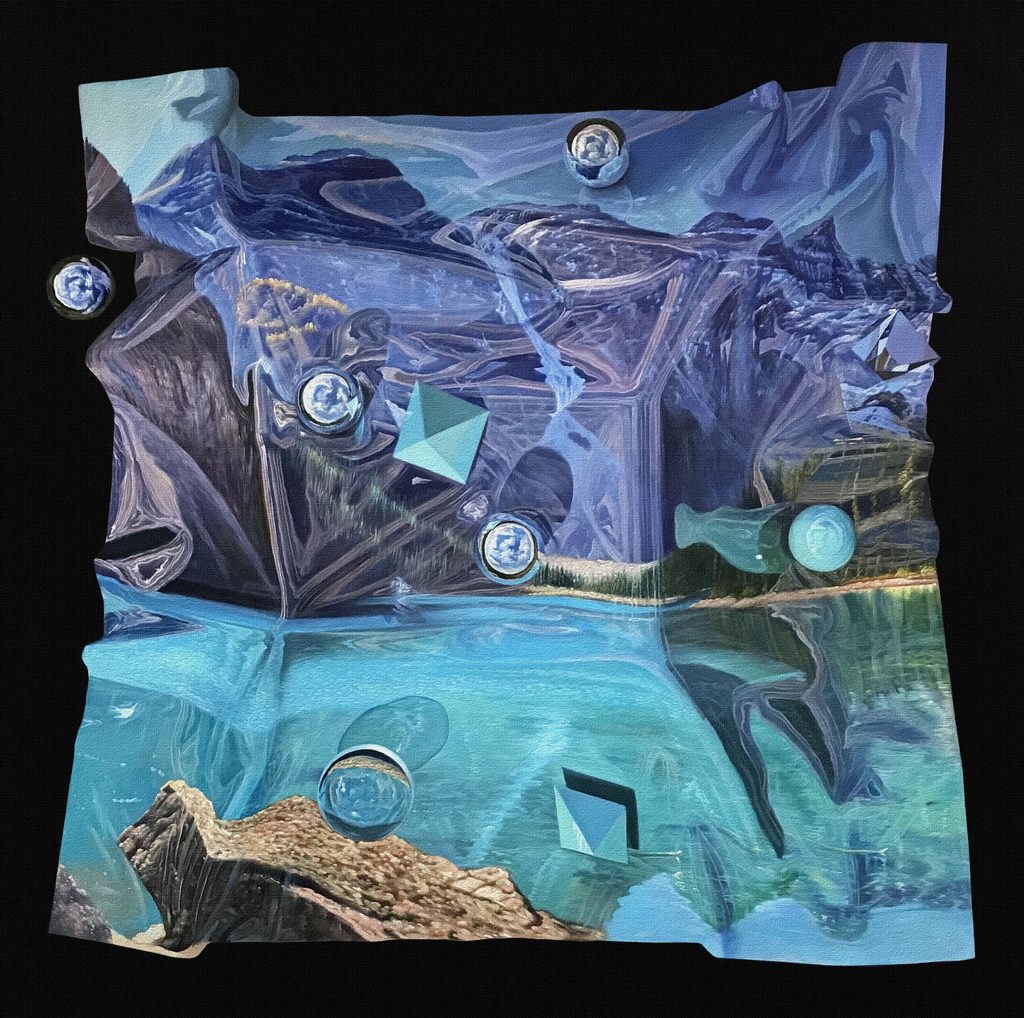
I think there is something about faith that I’m beginning to understand in those terms. My wrestling with it is particular to my life, but it also sits on the back of this enormous history of other people wrestling with many of the same questions. And there is a humility in that for me. My life can feel all-consuming when I’m inside it, and then suddenly I’m confronted with this vastness of time, history, and things we simply don’t know.
The red threads in the paintings have started to mean something slightly different to me because of this. They initially came through the story of Rahab and the scarlet cord. I’m drawn to Rahab because she is a woman at the margins, an outsider, and yet she is received into this much larger story through grace. The cord is a small thing, almost fragile, but it marks trust and the possibility of being held within something larger than herself.
In the paintings, I think the thread has become a way of holding things together too—not necessarily repairing them or making them resolve. It gathers periods of life, emotions, memories, even parts of ourselves that we are sometimes encouraged to discard in order to arrive at a cleaner version of who we are. Grief doesn’t have to disappear because joy has arrived. Doubt doesn’t have to be edited out for faith to be real. What has been painful doesn’t suddenly become meaningless because something beautiful follows it.
Perhaps grace has something to do with that for me now. Not the removal of all these contradictions, but the possibility that they can still be held.
So I don’t think faith has made the paintings more certain. If anything, it has allowed me to become more interested in uncertainty—in things obscured, barely formed, or unresolved. Maybe where I am now is not about knowing more, but recognising how much I don’t know, how many people before me didn’t know either, and somehow finding faithfulness within that.
In line with that, much of this series focuses on types of landscapes. How would you say your artistic definition of a landscape has shifted?
I’ve been thinking for some time that the landscapes are almost figurative paintings without figures. They are landscapes, certainly, but increasingly I recognise them as a kind of self-portrait.
A sea can hold a very different psychological space from a desert or a mountain. A horizon can suggest possibility, but it can also make you very aware of distance. So I think I’ve become less interested in landscape simply as something in front of me and more interested in what happens when an external place becomes entangled with an internal one.
There is a particular landscape in Colombia that became important to this series. We encountered this pink sea while we were there as part of our journey of starting a family. What interested me was that the pink wasn’t permanent. It emerged from very particular environmental conditions. So there was something strange about encountering this almost impossible colour in nature at this particular point in our lives.
I don’t think I understood immediately why it stayed with me. It was just a place we had been. But later it began entering the paintings, and the landscape started carrying the memory of what we were hoping for, what happened afterwards, and what we couldn’t have known at the time.
Maybe that’s the shift. A landscape is still a place, but it can also become a repository for time. The place remains where it is, while what it means to you keeps changing.
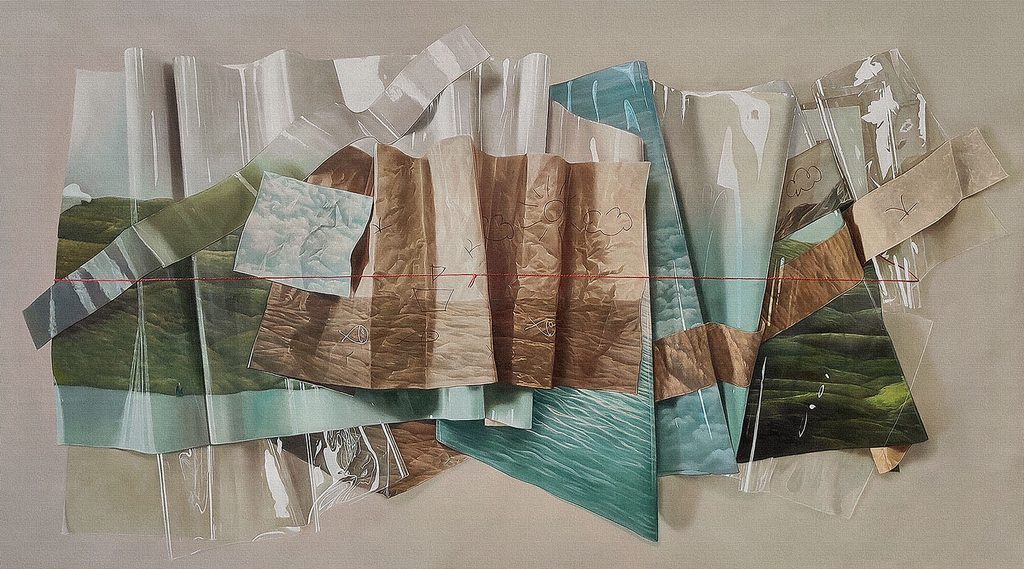
Lots of artists are exceedingly mindful of scale in Singapore, given our conditions of creating in restriction and having to consider the same for collector’s constraints. I see that your works are both sprawling and contemplative- How do you think you achieve this axis? Where can the balance lie for an artist who wants to go further than their current scale?
I think scale is something I’ve become increasingly interested in, precisely because working in Singapore makes you so conscious of it. There are very real considerations here—studio space, storage, transportation, and eventually where a painting might live. So you become quite pragmatic about size very quickly.
But I also don’t want those practical conditions to determine the limits of the work.
There is a particular feeling I get when I stand in front of a painting once it reaches a certain scale. I’m not sure it can be replicated simply by making a smaller work feel expansive. Your body enters into the experience differently. You can no longer take in the whole painting quite as immediately; your eye has to travel across it, and perhaps your body does too. With landscape especially, that interests me because the work can begin to feel less like an image of a space, and more like a space you are somehow standing within.
Maybe that’s also where the sprawling and contemplative qualities meet. I don’t necessarily want a larger surface because I want to put more things into it. Sometimes I want exactly the opposite. I want a larger expanse in which very little happens—a horizon, a stretch of colour, an interruption—and to give that emptiness enough physical presence that you have to spend some time with it.
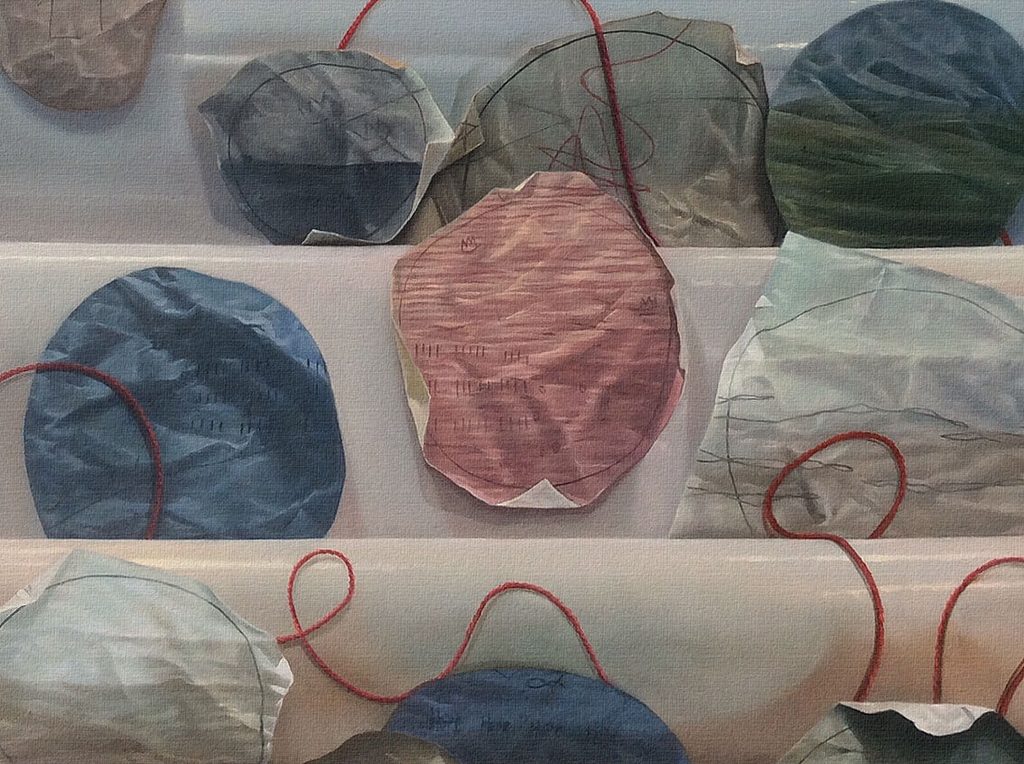
Photo caption: There is something slightly contradictory about making work this way in Singapore, and I’m quite conscious of that. We are conditioned to think about efficiency of space, and collectors understandably have physical constraints too. But I think there has to remain some room for an artist to make something because the work asks for that scale, even when it is inconvenient.
I’m still negotiating that myself. I don’t think going further always means going bigger, but neither do I want practicality to become the reason I don’t go bigger.
So perhaps the question I’m asking myself now isn’t simply, “How large can this feel?” but also, “How large does this need to be?” And if the answer is larger than what is convenient, perhaps sometimes you have to follow that.
To complement visual distortions, I’d like to elaborate more on your colour palette. What sort of hues are emerging now and how are they place-marking your anchors within the psyche, family, and identity?
Colour has become quite personal recently, although I’m hesitant to assign particular meanings to particular colours. I don’t really think, this pink means this, this red means that. It is more relational than that.
I’ve been introducing colours that I might previously have found difficult to place together, and then trying to find a harmony between them. Sometimes one new colour enters and suddenly everything that was already there has to be reconsidered. A colour that felt settled no longer feels settled because its relationship to everything around it has changed.
Similarly, my son isn’t arriving into an empty life. There is already a marriage, a studio practice, work, faith, friendships, responsibilities, histories—all these things that have accumulated over time. And now there is this entirely new person entering it. I don’t think the question for me is how to clear everything away and construct a new life around him. It is more: how do all these existing parts begin to form new relationships because he is here?
Maybe colour has become a way of working through that without illustrating it. When I introduce something unexpected into a painting, I have to listen to what happens around it. Perhaps another colour needs to shift. Something needs to become quieter. Something that was previously peripheral suddenly becomes important. And eventually a new harmony emerges, but it contains what was there before.
There are colours tied to actual places too—the pink water in Colombia, for instance—and those colours carry memories with them. But even those memories aren’t fixed. They change as my relationship to what happened changes.
So perhaps colour, for me at the moment, is less about symbolism and more about relation. What happens to everything that already exists when something new enters?
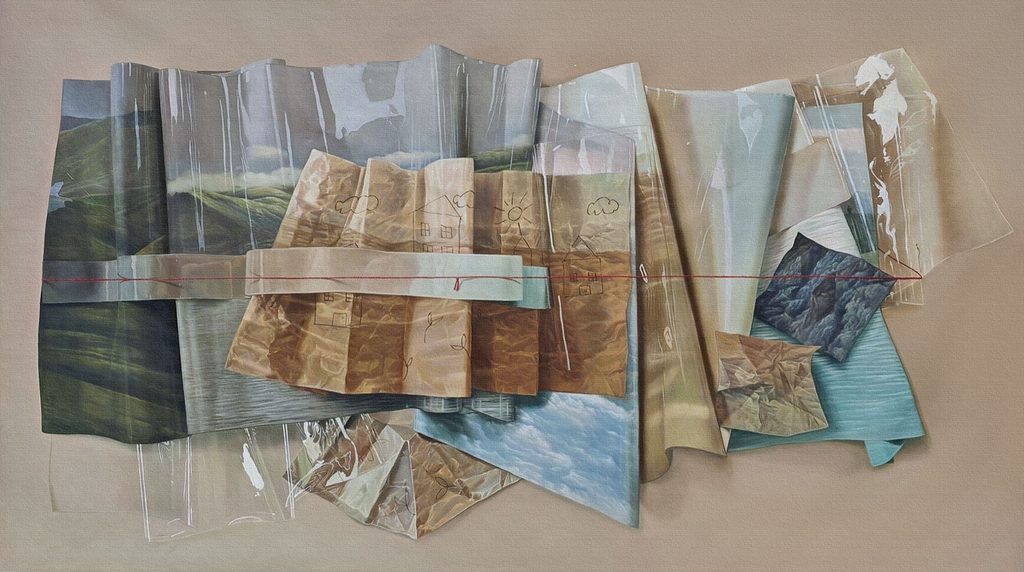
A constant reflex you have conditioned is seeking harmony in dichotomy: i.e. melding the masculine and feminine in gender, keeping a duality in innocence and sensuality, etc. How do you blend preconceived contrasts, in your life and your craft?
I’m not sure anymore that I want to blend them. Maybe that’s something that has changed.
Blending suggests that eventually the differences disappear into one another and you arrive at something resolved. I think I’m becoming more interested in allowing two seemingly contradictory things to remain distinct and asking whether they can still belong together.
Hope doesn’t necessarily cancel grief. Faith doesn’t remove unknowing. Becoming a parent doesn’t mean I stop being an artist, but it will inevitably change what being an artist looks like. Masculine and feminine don’t necessarily need to resolve into some neutral middle ground either. Perhaps the tension between things is where something else becomes possible.
I suppose I’m approaching this from the idea of natality Arendt speaks of. What I find beautiful about it is that birth is not simply the appearance of something new in isolation. We are born into a world that already exists—into histories, relationships, circumstances, even tragedies that precede us. And yet every birth introduces the possibility of a new beginning within that existing world.
Maybe harmony, then, isn’t the absence of contradiction. It is finding a way for differences to remain differences, while still being held together.
What are your plans after this series, artistically?
There are questions from ‘Of Particles and Particularities’ that I don’t feel finished with. If these paintings are partly about how fragments gather into something we recognise as a life or a self, I’ve started wondering about the self that is doing all this gathering in the first place. Where does it begin and end? How fixed are those boundaries? What can we imagine that might lie beyond what can be sensed?
And then, very practically, I don’t actually know what fatherhood will uncover in my practice. My time has changed, my attention has changed, and the conditions under which I make things are already changing. Dolly Parton’s recent passing brought me back to something she once said: “I’ve dreamed myself into a corner.” It made me laugh because, in some ways, I suppose I have. Now I have to see what I make from here.
‘Of Particles & Particularities’ will be on view at Haridas Contemporary, Singapore, from 7 November to 6 December 2026. For more information, please click here.
Source: This feature is courtesy of Euginia Tan, Exhibition Writer at Haridas Contemporary.