
The transcript below is a partial transcript, scaled back to fit AWDB’s formatting, and reposted from the Singapore Art Museum’s ‘In Focus with Afterimage’, a conversation exploring the practice of Filipino artist Maria Taniguchi alongside her exhibition ‘Afterimage’ at SAM. Joining Taniguchi was art historian and longtime collaborator Patrick Flores, with the discussion moderated by SAM curator Haeju Kim.
Spanning Taniguchi’s early artistic formation in Dumaguete and Mount Makiling through to her recent work, the conversation considers how materials, repetition and physical processes of making have shaped her practice. Here, we share a selection of five questions from the panel, covering her relationship to abstraction and materiality, the influence of her early education, the role of biography in her work, and how she understands ‘Afterimage’ itself.
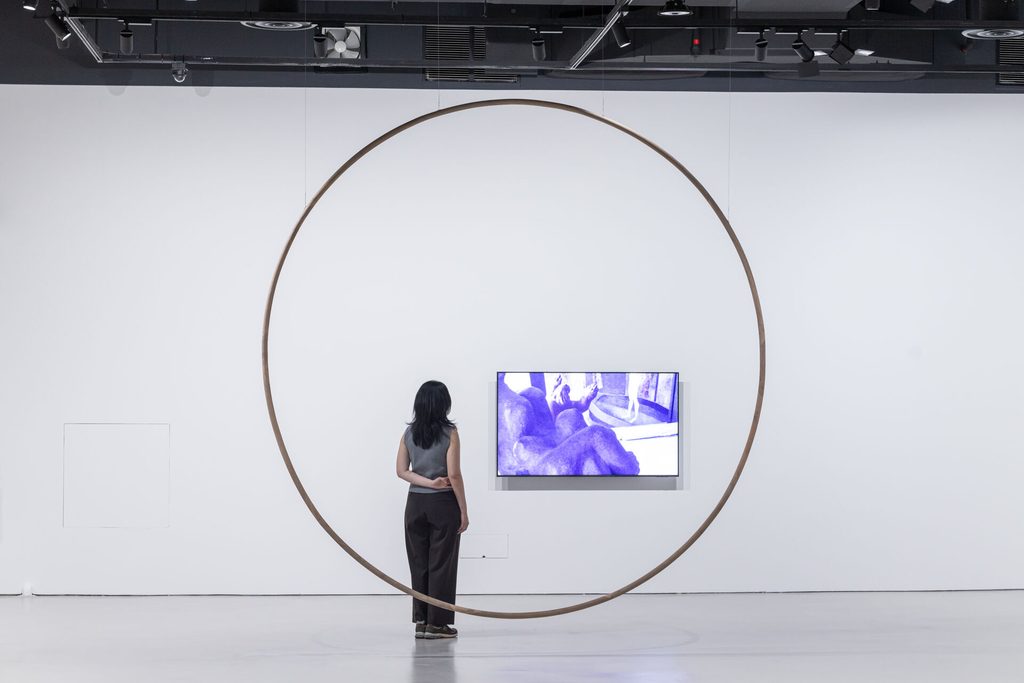
Maria Taniguchi, ‘A painter, if black were a place’, 2026, installation view, as part of ‘Maria Taniguchi: Afterimage’ at SAM at Tanjong Pagar Distripark. Image courtesy of the artist and Singapore Art Museum
Haeju Kim
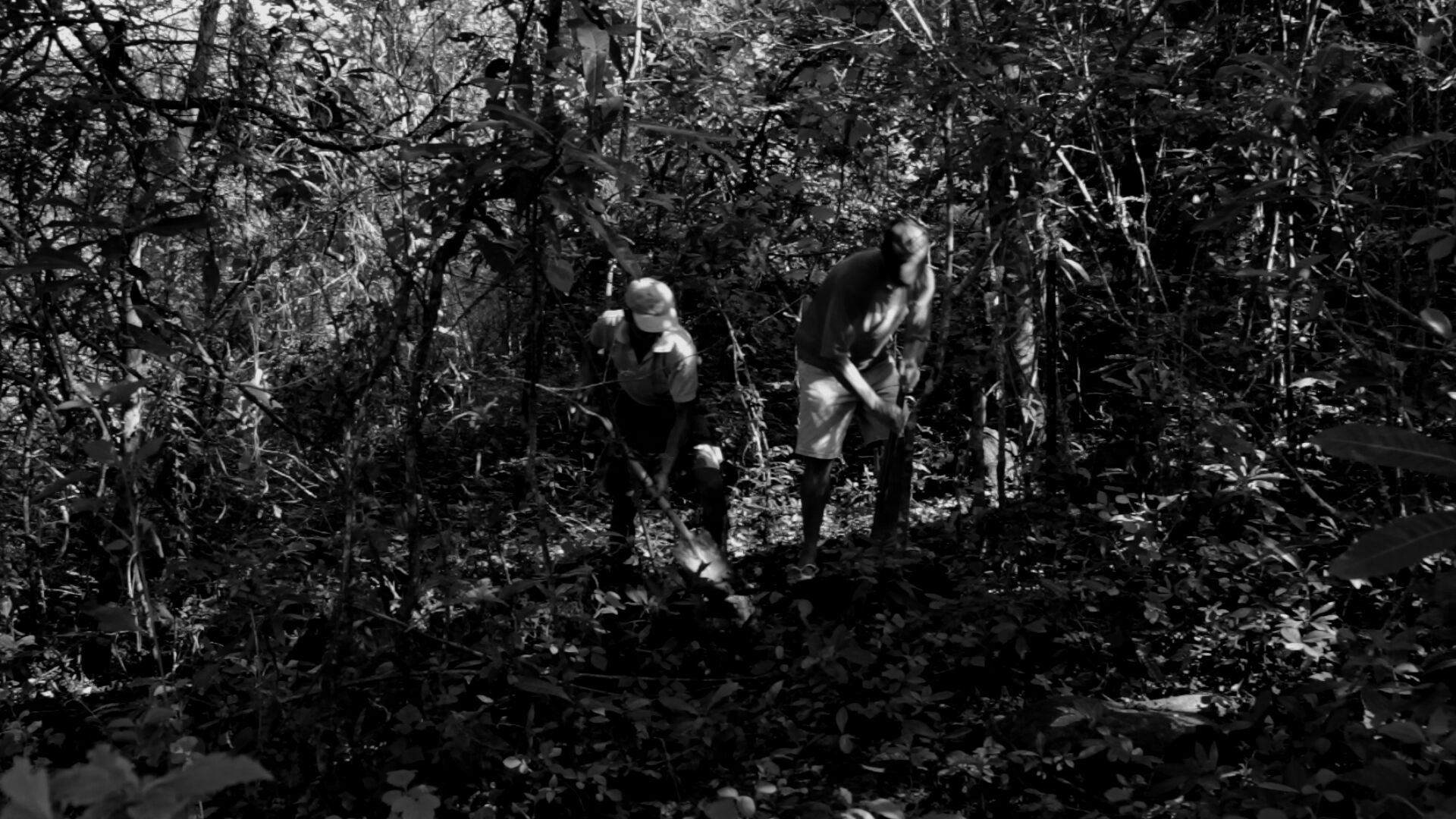
Let’s talk about your early formation at the Philippine High School for the Arts in Makiling, which seems to have strongly influenced your interest in materials. The exhibition begins with two videos, both titled ‘Figure Studies’, and particularly the 2018 video directly engages with your experience of the school and its methods of teaching.
How did your early formation at the school influence your method of working? And how did the idea of revisiting this experience through ‘Figure Studies’ in 2018 come about?
Maria Taniguchi
So, at the Philippine High School for the Arts, it was a boarding school, and so we lived on top of a mountain. It was the peak of Mount Makiling, which is quite a mystical site. It was actually really beautiful. It was set in the forest, and there was a complex there where the dormitories were set, and also the studios for the arts. So we had to go through this forest every day and experience it every time we moved from our dormitories to the canteen, from the dormitories to the art studios.
Pedagogically speaking, the method was to use whatever was there. So we had these Black Mountain School-type exercises wherein, for example, we would find, let’s say, a mattress on the roadside and we would try and create an installation with it. So this exercise, this particular exercise, is the one that made its way into the video that is in the gallery.
I guess, in terms of the way that it influenced the way that I make work, I think it has more to do with finding what’s there and using it. In terms of the language, for example, of the brick paintings and its relationship to minimalism, it is quite a fraught thing. I think it’s a very difficult question for me to answer. But I would say that it is an established vocabulary that I treat as a kind of found object, in a way. And I use it, but it is not the main focus of my work. It is something that is there, that exists as a type of framework, that is one of the layers that I think my work can bounce off of or traverse through—something that my work is conscious of and senses—but it is not… I think it doesn’t come from the same stem cell.
The paintings are very… I don’t know. I guess I would say DIY, in the sense that I have approached it as a more grounded being. I’m saying “being” because I see the paintings as a body.
Breaking it down a little bit for you, this brick form, I don’t see it as an abstract form. I see it more for its sense of compression. Like, how is a brick made? Like a physical brick. You take some earth, and you put it in a mould, and you apply pressure from several sides in order to make this brick. And that is what interests me the most about these brick cells that are in the painting: their capacity to contain and retain information, and maybe to reflect it back in some way.
So, in that sense, the paintings are all about materiality and a certain type of materialising—materialising an object or form, or an idea. And so it’s definitely not related to the kind of established vocabulary of minimalism.
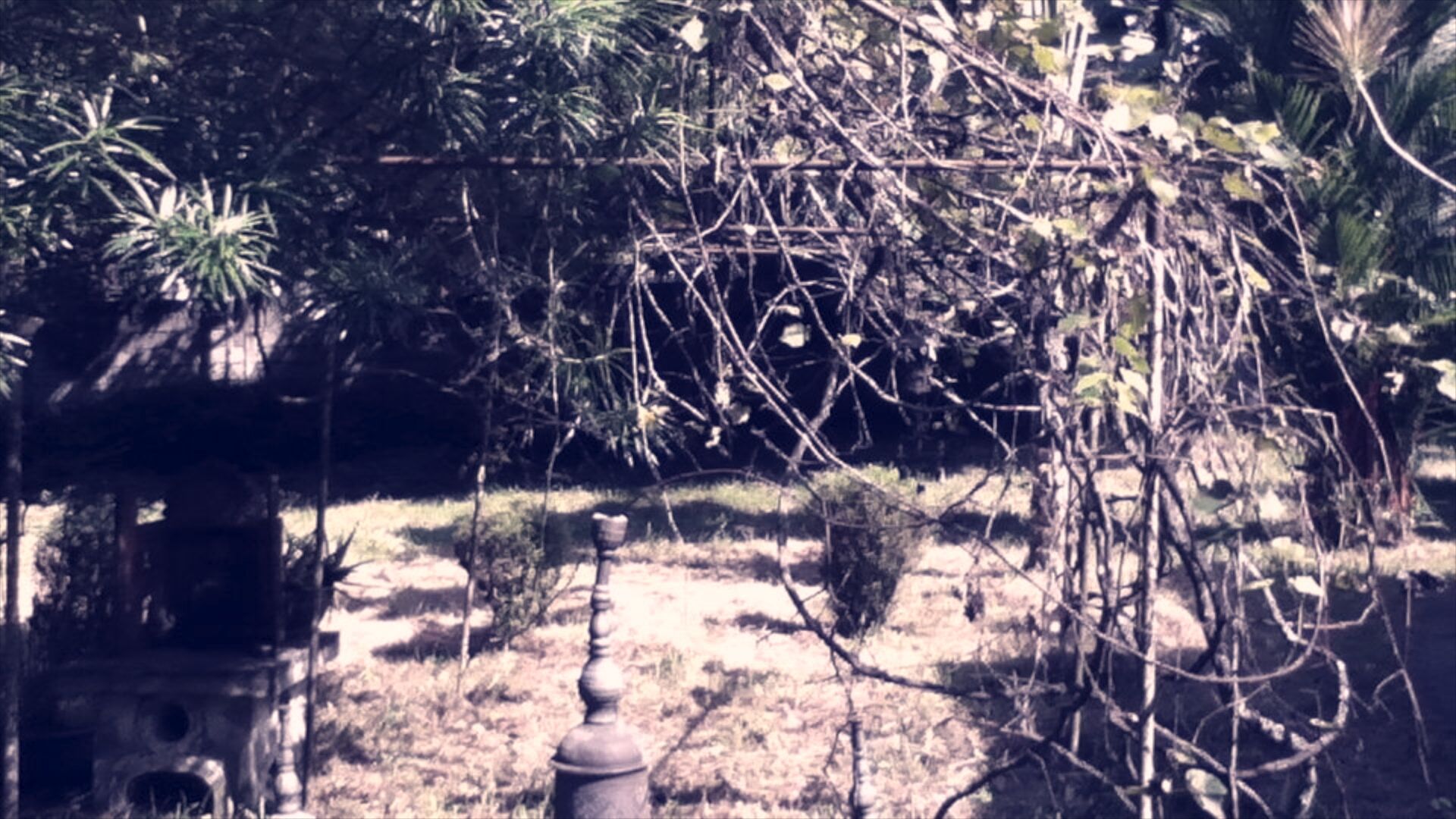
Maria Taniguchi, ‘A painter, if black were a place’, 2026, video still, as part of ‘Maria Taniguchi: Afterimage’ at SAM at Tanjong Pagar Distripark. Image courtesy of the artist and Singapore Art Museum
Haeju Kim
Your description of the brick paintings and the materiality within them made me think about our earlier discussion of black, particularly in your newest video in the exhibition, ‘The Painter: If Black Were a Place’. The work alternates between still photographs taken in your mother’s house in Dumaguete and moments of black between the images. These are not simply blank or empty screens, but painted surfaces that you made yourself.
The title also invites us to think about black not simply as a colour, but as a place—perhaps somewhere one can enter, or where memory stays. This also brings me back to your brick paintings, where the individual black rectangles are images but also seem to occupy space and almost have volume, particularly in the way the paintings are installed leaning against the wall.
Could you speak more about this idea of black as a space or place? What does it mean to imagine black as a place, and what possibilities does this open up for you?
Maria Taniguchi
I’ve been painting with black for 17 years now, but I never thought about it before. I think it’s a bit counterintuitive to say that, but I think maybe because I was in the space of black, I was not able to reconsider it from outside of itself.
But in recent years, the painting has shifted a little bit, and some of the different chromatic shades have started to enter the paintings. Recently, they have become a little bit whiter, which has led me to be able to think about black. So I kind of started to separate myself from this colour and started to consciously think about it, which led me to making this new video called ‘The Painter: If Black Were a Place’, which is a video that shows some images from the studio of my mum, interspersed with some black slides.
Now, I don’t know who took the photos. It almost feels as if somebody walked out of the painting and put the photos in my hard drive, because I was actually just planning to go to my mum’s place to take some videos in order to make this work. But as I was cleaning out some of my hard drives, I found a folder that said Dumaguete, and when I examined the photos, I found that they were from some time in the past, and they were taken by a camera that I didn’t recognise. But I thought that they were the perfect images to make this work. So I decided to use the photos in a sequential order with my own paintings of black.
So it’s image, black, image, black, image, black, but then the blacks are also objects, as you’ll notice at a later stage when you’re watching the video.
So I started to think: what is black anyway, in the framework of my painting, in this system that I have developed over some time? Is it appropriate now to say, where is black? For example, is it a place? Because the videos, the way that they function, are also like notes that are interspersed between the paintings, and to start to pay attention to them and to start to take clues from the notes that have been put in there has led me to think that maybe black is something, a point of… there’s a local point in this black. It exists somewhere, and I would like to really examine and go to this place.
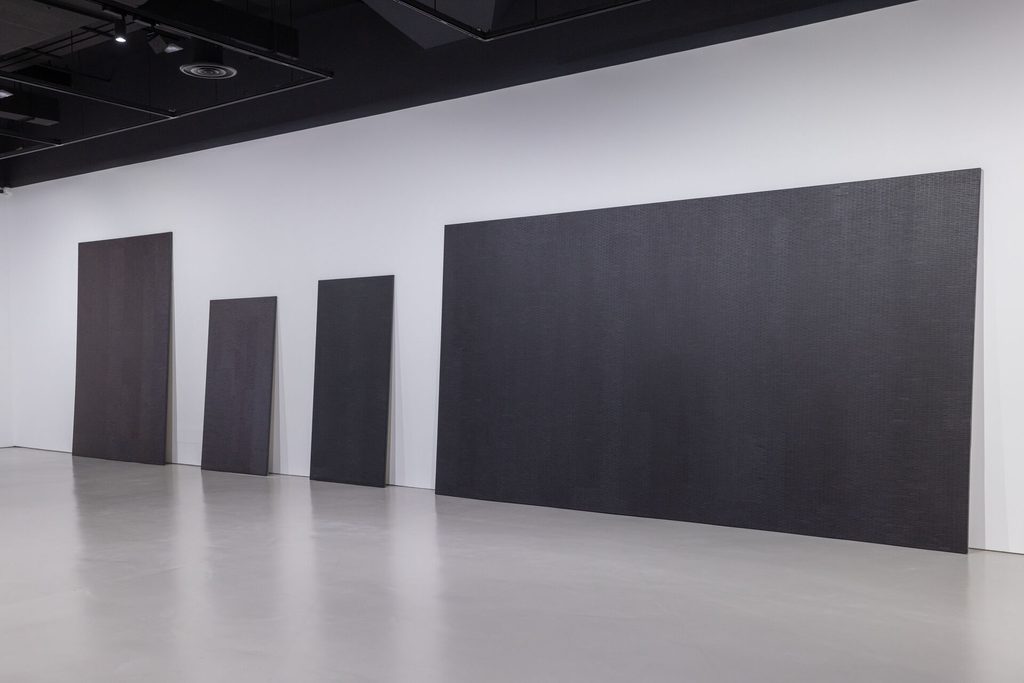
Maria Taniguchi, ‘Untitled’, 2022–2026, installation view, as part of ‘Maria Taniguchi: Afterimage’ at SAM at Tanjong Pagar Distripark. Image courtesy of the artist and Singapore Art Museum
Haeju Kim
You just described the images in the video as objects, with the black space following them almost as a negative space. This makes me think about moving image as sculpture, and painting as sculpture. You have also described the brick paintings almost as if you are sculpting with paint.
Your work moves across the boundaries between painting, sculpture, photography, film and writing. I wonder whether that fluidity is made possible, in part, by your use of reduced forms—simple shapes, repetition and more austere structures.
Do you consciously think about transferring the logic or grammar of one medium to another, such as approaching painting in a sculptural way or bringing sculptural thinking into film? Or has this developed more intuitively through your practice?
Maria Taniguchi
I think that most of the forms exist in one space, so they’re actually refractions of each other. So, in my conception of this space, the paintings exist as a type of space in which the videos can also place themselves, and then the sculptures, ‘Runways’, for example, also reflect the inherent logic of the brick paintings. So there is, I think, a transmutation between each of them with regards to their inner logic, like how they function.
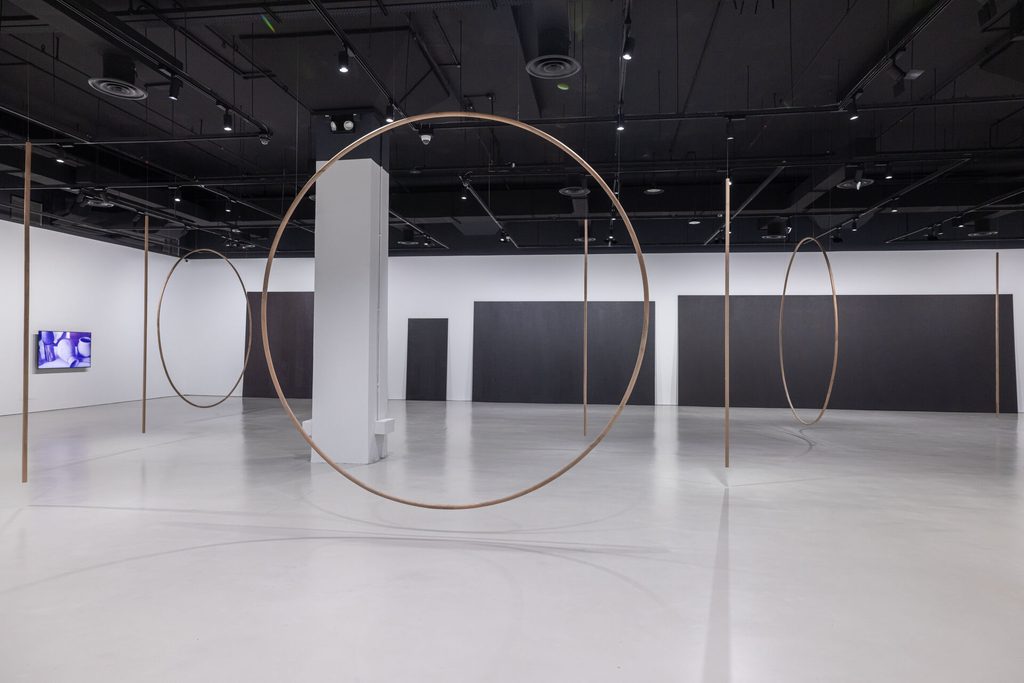
Maria Taniguchi, ‘Runaways’, 2026, installation view, as part of ‘Maria Taniguchi: Afterimage’ at SAM at Tanjong Pagar Distripark. Image courtesy of the artist and Singapore Art Museum
Haeju Kim
In the new video, there are scenes showing your mother’s house and studio, as well as fragments of her paintings. But these autobiographical aspects are not explicitly explained within the work itself. They might open up another layer through which to read your practice, but I also wonder whether bringing biographical stories into the discussion might narrow the way we understand the work.
Do you see your practice as being connected to your own beginnings, including your relationship with your mother? And how do you feel about these personal relationships being brought into discussions of your work?
Maria Taniguchi
I think I often describe my work as work about making work. And I think this is why I always gravitate towards painting, or the practice of being a painter, because it’s something that’s really slow. You can’t rush a painting, and you have to approach it day by day in the rhythms of a studio. And the problems that you encounter when you’re painting, they’re often very subtle. It has to do with, you know, maybe just adding 20 centimetres more water, or mixing a tiny bit more brown, and it changes everything.
And you go through this, and this is what the process is for thinking. So it is a type of research and thinking and hand practice and eye practice rolled into one. And this is what you do for maybe eight hours a day in the studio, and that is really attractive and grounding to me because it is what generates the work. It is a generative process, and it generates certain forms of knowledge in a very mysterious object. That is the painting.
So, with regards to biography, I kind of invite this in some of my work, but I’m really more interested in quotidian time, things that are around us. And maybe earlier in my practice I didn’t touch so much on biography, but now biography is entering my work a little bit more because I see it simply as information. It’s something that is around my work, and I see it not as something that is deeply personal. Although it is, yes, I think that it is what is there, and it is inside the work, and it surrounds it. And I think it has to be examined also, if I were to think about my work as a more grounded system.
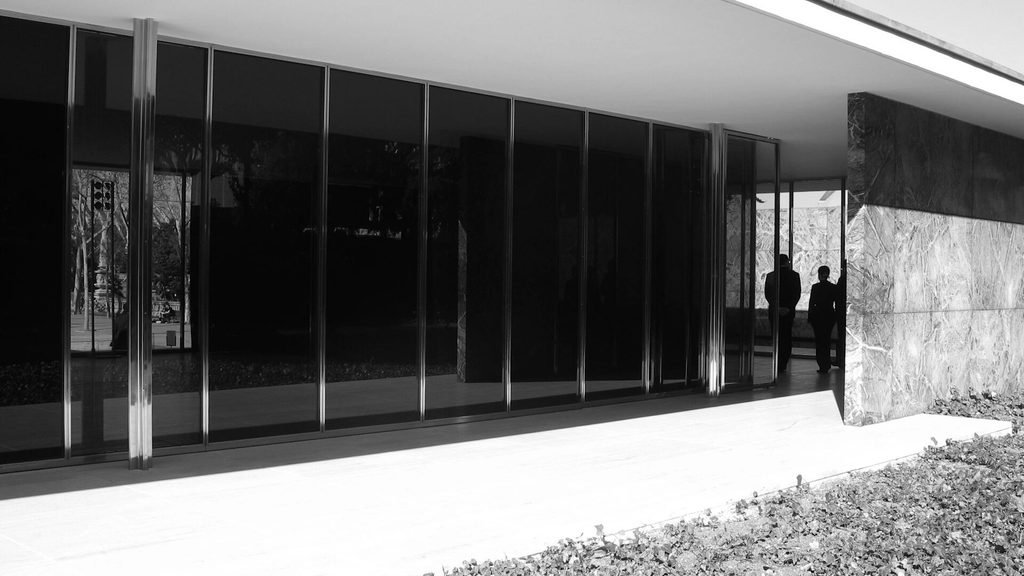
Maria Taniguchi, ‘Mies 421’, 2010, video still, as part of ‘Maria Taniguchi: Afterimage’ at SAM at Tanjong Pagar Distripark. Image courtesy of the artist and Singapore Art Museum
Haeju Kim
I feel that, in that sense, this exhibition perhaps contains a bit more personal information than your previous shows, especially with this new video.
As for my last question, you’ve been thinking for a while about the title ‘Afterimage’, which is quite intriguing. How do you understand ‘Afterimage’ in relation to the exhibition you’ve just opened?
Maria Taniguchi
I think it has to do with materiality. ‘Afterimage’, I think we most associate with something optical, something that has to do with vision. But for me, it’s about materiality and the transfer of a body from one form to another.
It’s almost like my body being sublimated into the paintings, for example, as I talked about earlier, with regards to my first kind of learning about painting through my mum, and which later on, now as I can see, since we’re tracing formations of subjectivity, what I’m seeing now is that this same transference is happening in terms of myself, my body, and the paintings, for example, through the process that I’ve chosen to make the paintings.
‘Maria Taniguchi: Afterimage’ is on view at Singapore Art Museum, Singapore, until 22 November 2026. For more information, please click here. To watch the full panel discussion, please click here.
Source: This feature is transcribed by AWDB and published courtesy of Singapore Art Museum.