
Situated between Australia and Indonesia, Timor-Leste is Southeast Asia’s youngest country and a recent entrant to ASEAN, joining on 26 October, 2025. With a population of just over 1.4 million, its debut at the 60th Venice Art Biennale in 2024 – with the national pavilion represented by Maria Madeira – marked the country’s arrival on the international art circuit.
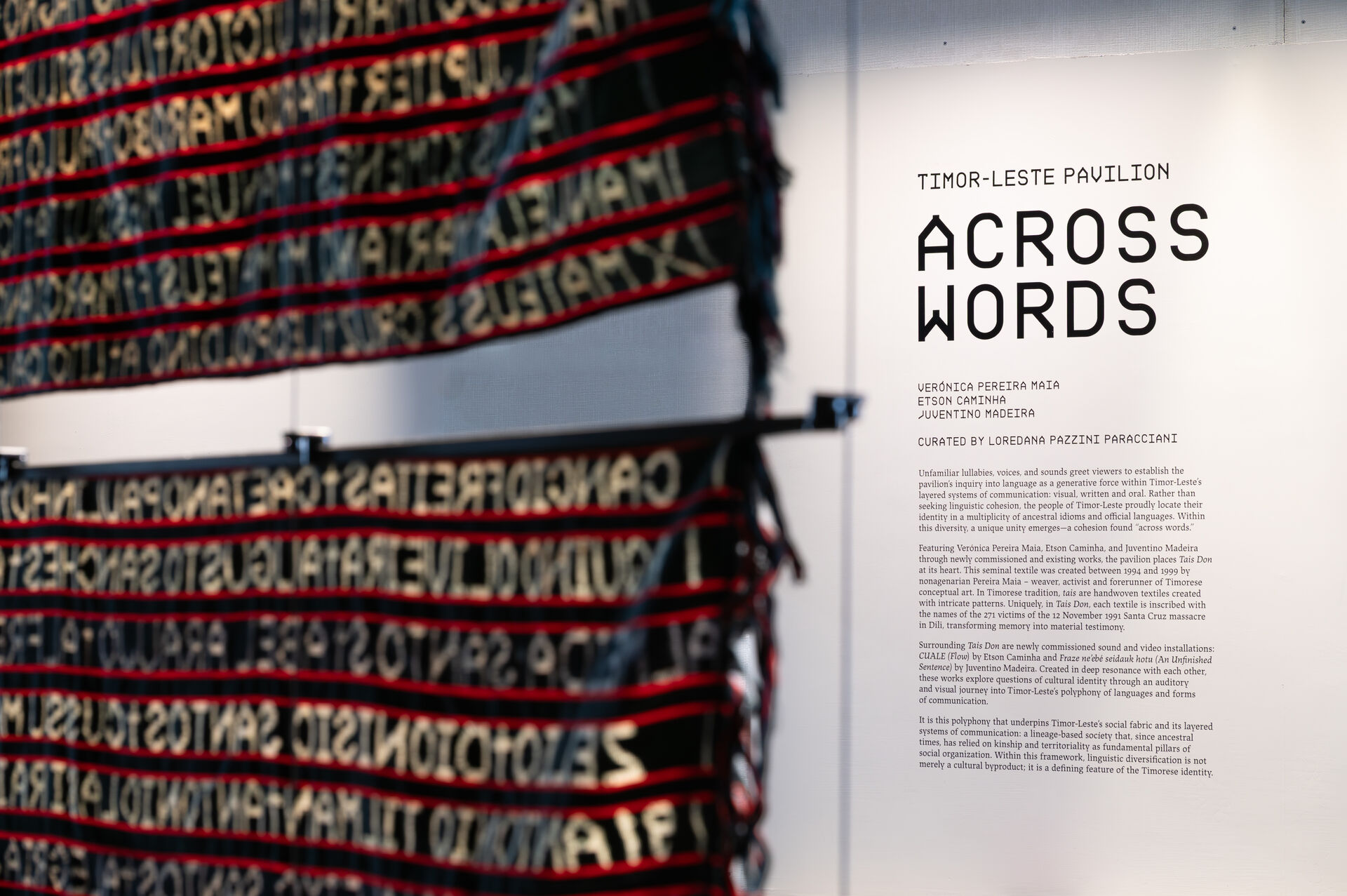
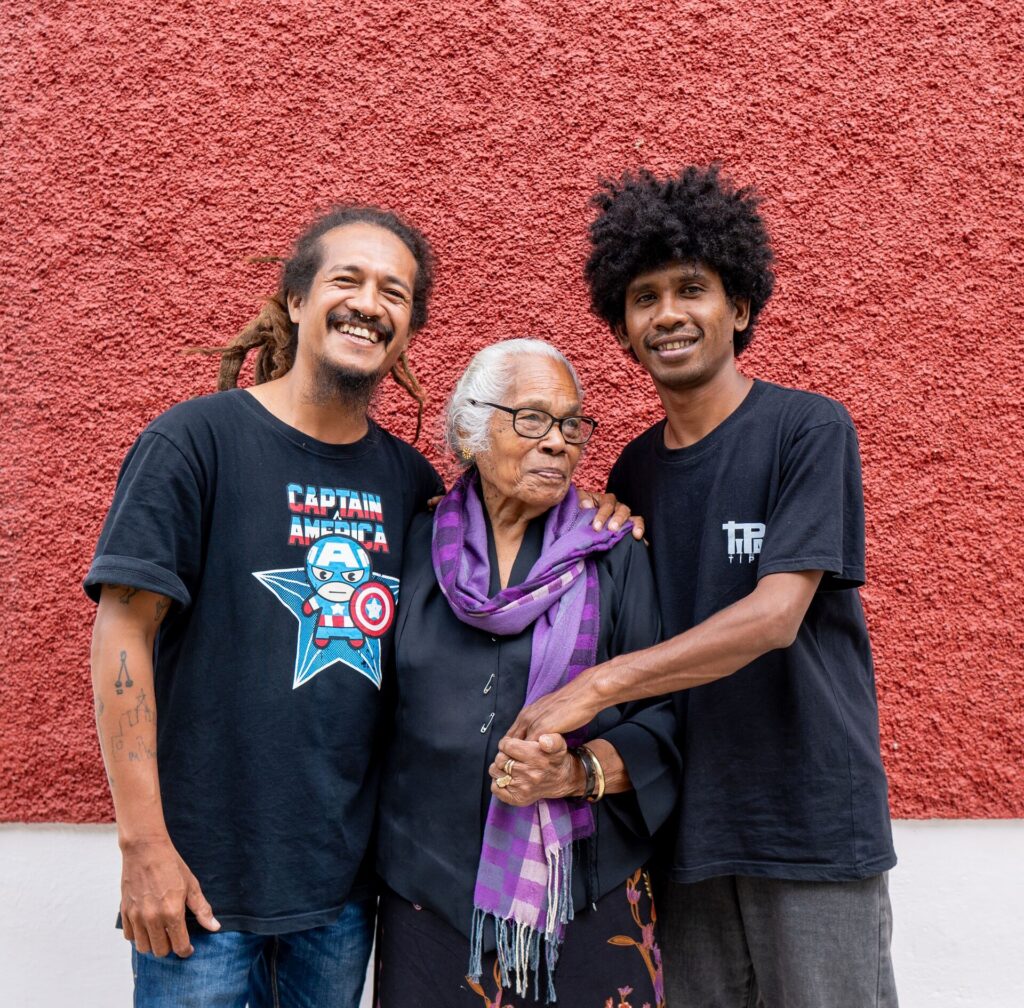
At the 2026 Biennale, the Timor-Leste Pavilion at the Arsenale brings together three artists from different generations: Verónica Pereira Maia (b. 1930), whose practice centres on the traditional textiles of Timor-Leste, musician and sound artist Etson Caminha (b. 1984, and Juventino Madeira (b. 1994), a multidisciplinary visual artist and filmmaker. Curated by Loredana Pazzini Paracciani and titled ‘Across Words’ (Liu Husi Liafuan in Tetum), the exhibition explores language and oral memory through textiles, video, and sound installations to examine the country’s identity.
Language is fluid, and the evolution of Timor-Leste’s linguistic landscape is complex, shaped by indigenous roots with successive colonial histories. For centuries, more than 30 indigenous languages have been spoken; while most are Austronesian, some in the eastern part of the country belong to the Papuan family. In the absence of written tradition, ancestral knowledge was passed down orally through tales, epic sung narratives, and tribal circle dances. Physical objects served as markers; leaves, wood carvings, and animal bones defined boundaries, while the patterns of Tais (traditional woven textiles) functioned as visual language, indicating clan origins and social structures.
Colonialism and occupation brought further linguistic diversity. Colonised by the Portuguese for over 400 years and occupied by Indonesia from 1975 to 1999, Timor-Leste finally gained independence in May 2002. The successive colonial history created a complex multilingual framework, with the Portuguese language banned during the occupation, and Bahasa Indonesia imposed as the sole language. To resist assimilation, the Catholic Church adopted Tetum, the dialect spoken in the capital, Díli, as its liturgical language, transforming it into a vehicle for cultural and national identity. Over the years, Tetum Prasa emerged as the lingua franca for trade, and after independence in 2002, it joined Portuguese as one of the country’s two official languages. Notably, Tetum Prasa only fully became a written register in 2004.
Today, Portuguese is used mainly for formal legal and official documents, Tetum for political discussion and daily administration, and Indonesian—though no longer official—still functions as an unofficial working language. English, another contact language, is also widely spoken. This linguistic diversity does not just coexist; it actively drives life and the arts. Modern music in East Timor mainly uses Tetum Prasa, and Portuguese is common in fado-style ballads. Street and mural art use Tetum for local political messages and English for global visibility. In contrast, indigenous artists deliberately use smaller local languages in poetry to preserve them and resist Tetum’s cultural dominance.
On one of her research trips to the country, curator Loredana Pazzini Paracciani was struck by this diversity,
‘‘Nothing prepared me for experiencing so many languages and sounds all around me, or witnessing the pride everyone had in telling me exactly where they were from—which municipality, which village, which clan, and therefore, which language.”
‘Across Words’ emerged from this experience, as well as from her encounter with ‘Tais Don’, a seminal textile work created between 1994 and 1999 by the weaver and activist Verónica Pereira Maia, while living in the diaspora in Darwin, Australia.
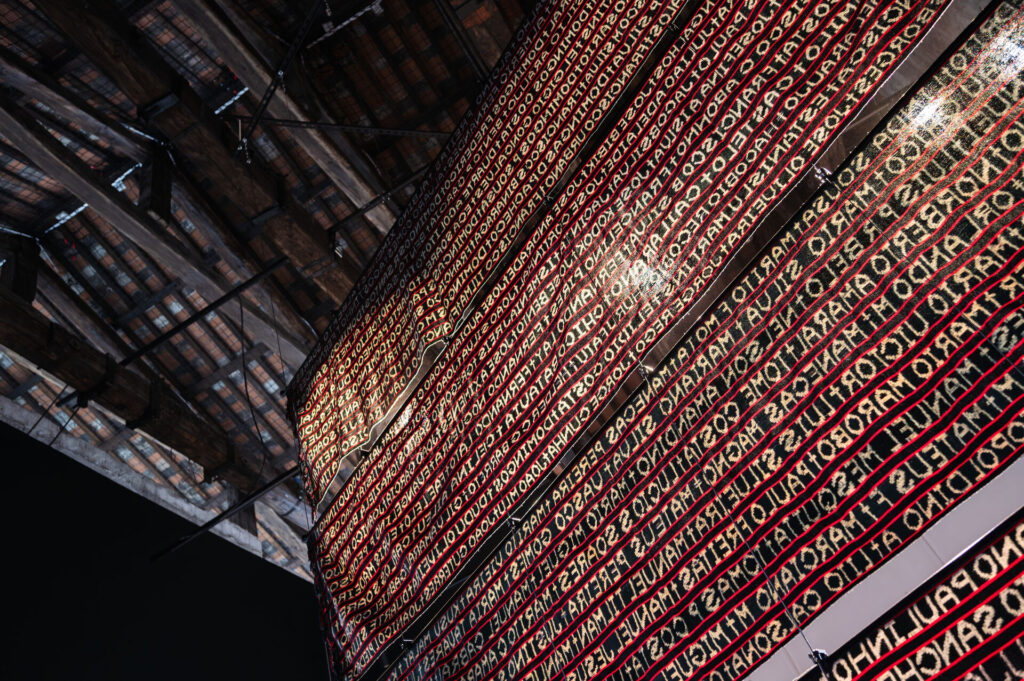
‘Tais Don’ is considered a national treasure and a pioneering work in the country’s conceptual art. The five-panel embroidery, made with cotton threads and natural dyes, anchors the Timor-Leste pavilion and welcomes the audience. Departing from the traditional geometric patterns and organic tribal symbols of traditional Tais, it uses the alphabet to inscribe the names of the 271 victims from the Santa Cruz massacre in Díli on 12 November 1991. The massacre marked a turning point for the country’s resistance, after British filmmaker and journalist Max Stahl documented it on film. The images were shown around the world, making the brutality of the Indonesian occupation impossible to deny. As Verónica didn’t know how to write when she began weaving, she used phonetic approximation to spell the names as they sounded.
Verónica Pereira Maia was invited to join the exhibition at the Venice Biennale.
“With her, I never had a single doubt—she had to be in the show. She was my only absolute certainty… the ‘Tais Don’ is the apotheosis of all of this, deeply intertwined with political activism,” says the curator.
The other two artists, Etson Caminha and Juventino Madeira, were selected from among 30 applicants through the official open call and commissioned to create works responding to the pavilion’s theme and Verónica’s ‘Tais Don.’
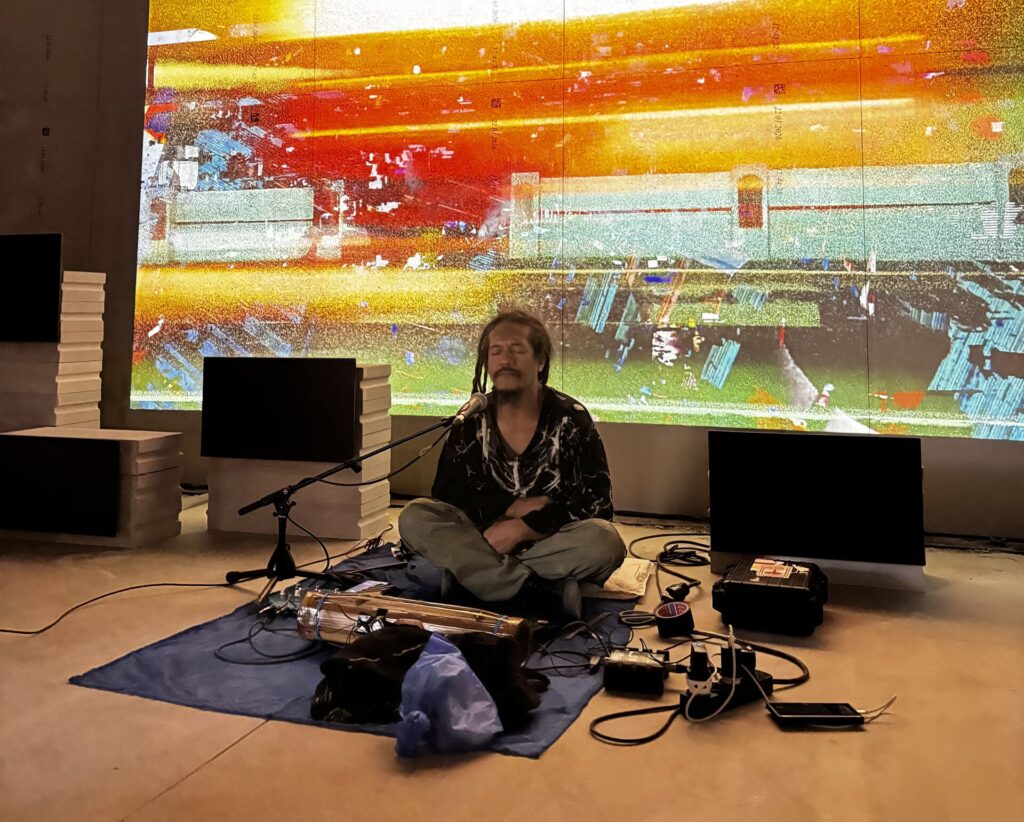
Before the visitors even enter the pavilion, they can hear Etson Caminha’s layered soundscape. ‘CUALE (Flow)’ challenges the idea of a single language as the basis of Timor-Leste’s national identity. Etson weaves together songs, elders’ voices in different local dialects, church bells (a reference to the Portuguese colonisation), poems, and imaginary words from a language yet to be created, producing a rich sonic experience.
In a conversation with the curator, he reflects on the power of sound,
“Sounds transmit our feelings and emotions, and they can take us back to memories and how our ancestors created sounds. I also incorporate specific ritual words – words spoken only at certain moments – and even without understanding all their meanings, we can feel the power of those words and their sounds.’
In his experimental approach, sound and music become language.
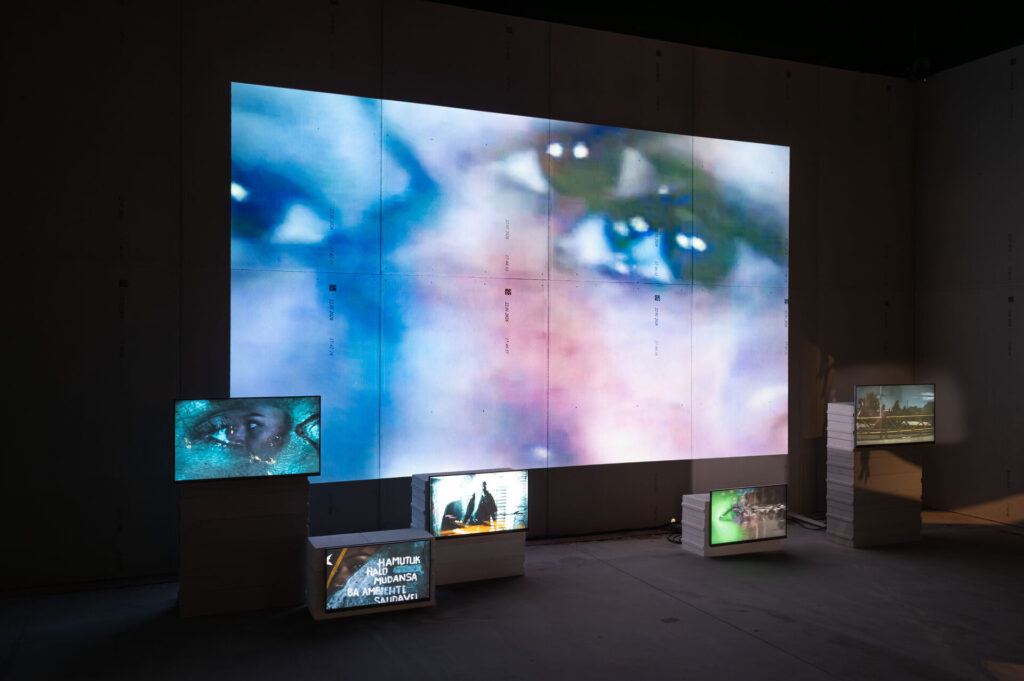
The five-channel soundscape also includes a soundtrack created for Juventino Madeira’s video installation ‘Fraze ne’ebé seidauk hotu (An Unfinished Sentence)’, which is shown on the back wall of the pavilion. Blending archival footage and new images of contemporary Timor-Leste, along with newspaper headlines addressing social issues, the work follows history through the eyes and gestures of a young woman as she dances from the darkness of the past into the present. It shows scenes of local markets and street life in urban and rural Dili, captured with a handheld camera. The six-channel video installation reflects on the rapid social changes happening in the country – from the trauma of occupation to the digital era. Rather than answering these questions, it leaves them open, as the title suggests, for the audience to complete like an unfinished sentence.
About this work, Juventino says,
“My installation is contemporary in approach. I hope people feel curious, and perhaps emotional. If they feel confused, that’s not a problem – confusion can become a doorway to reflection. It can prompt questions about the images, their meaning, and their origins. That curiosity might encourage the audience to learn more about Timor-Leste and its development today.”
‘Across Words’ brings together three artists from different generations, each speaking a different language, and weaves sound, image and textile to present language as a living system of transmission – one that reaches beyond the written and spoken word. The pavilion offers a vivid portrait of Timor-Leste: a young nation with an ancient history, where indigenous knowledge, resilience, and experimentation continue to shape the contemporary art scene.
A publication featuring essays by Southeast Asian scholars, historians, artists, and curators accompanies the exhibition and offers a broader perspective on the country’s contemporary culture. It is called ‘Across Words. An Anthology Pavilion of Timor-Leste at the 61st International Art Exhibition – La Biennale di Venezia’.
Link to publication:
‘Across Words’ can be seen at the Arsenale during the 61st Venice Art Biennale, which runs until 22 November 2026. For more information, please click here.
EDITORIAL BY GUEST CONTRIBUTOR ALESSANDRA DIAS, AUGUST 2026.